National Park · South Region · Protected Areas of Madagascar
Zombitse
Vohibasia
Three forest blocks rising from south-western Madagascar's subarid plateau, the only protected area on earth sheltering the gecko Phelsuma standingi and the endemic greenbul Phyllastrephus apperti.
About the protected area
Three forest blocks, site of exceptional biological interest
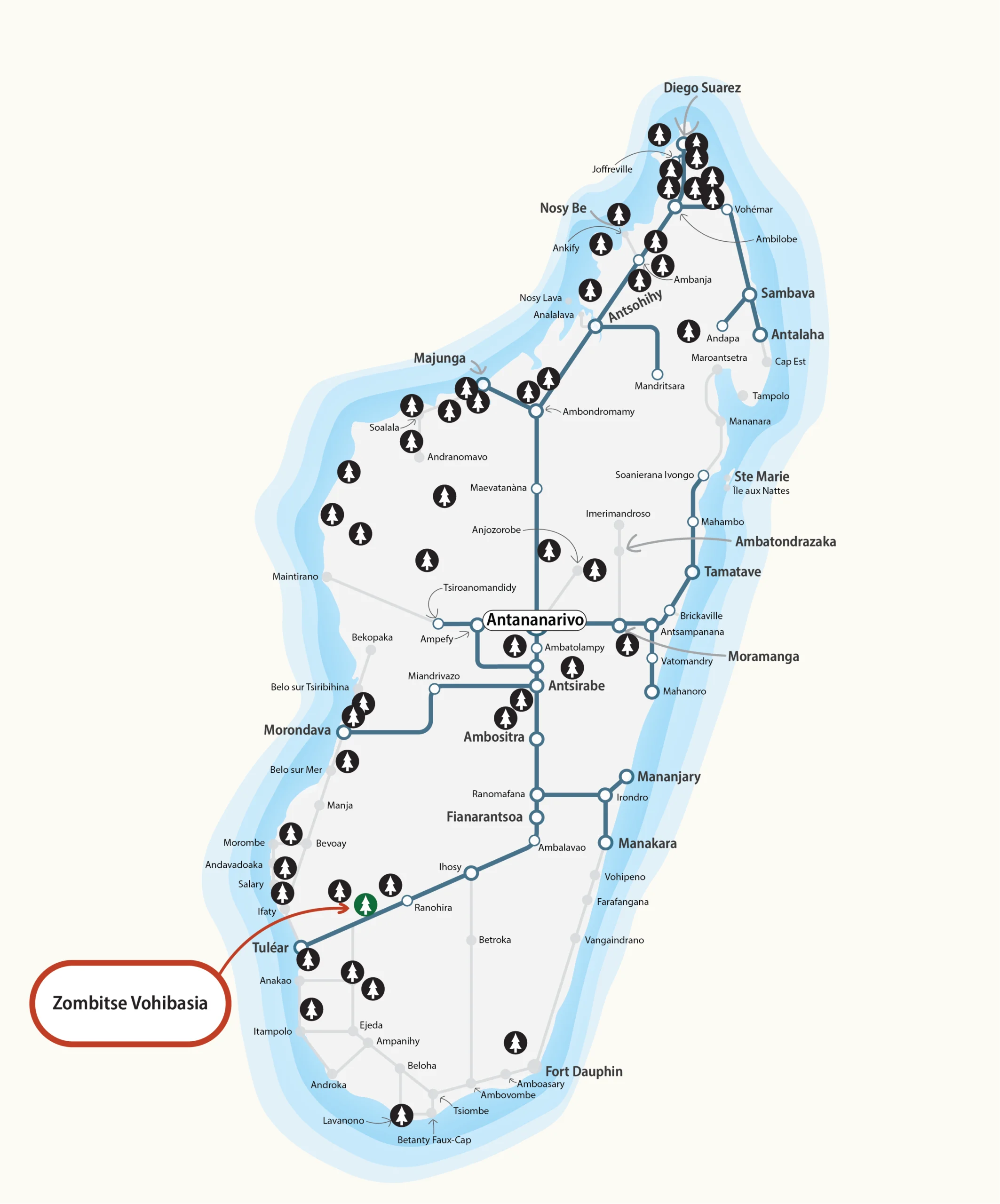
Zombitse Vohibasia National Park is composed of three separate blocks stretching from north to south: Vohibasia (16,170 ha), Isoky-Vohimena (3,293 ha), and Zombitse (16,845 ha). Located in south-western Madagascar, the park sits 135 km north-east of Toliara and is recognised as a site of outstanding biological interest.
The park entrance is reached via the RN7 at Ambakitany, 10 km east of Sakaraha and approximately 150 km from Toliara. A 6-km signposted tourist circuit has been developed within the park. Madagascar National Parks maintains its management office in Sakaraha.
The park entrance is on the RN7 at Ambakitany, 10 km east of Sakaraha, 150 km from Toliara. The MNP office is in Sakaraha.
Fauna and Flora
Semi-deciduous forest, endemic at every level
The climate is subarid, typical of the south-western zone: a cool season from June to August with temperatures around 12 °C, a hot season from September to November peaking above 35 °C (with the highest heat in December and February), and a rainy season from November to April.
The protected area is dominated by semi-deciduous moist dense forest, blending characteristics of both humid and dry forest types. Flora highlights include two species of Didiereaceae, a family emblematic of this region, alongside several baobab species including dwarf baobabs and Grandidier's baobab. The dominant plant families are Euphorbiaceae, Fabaceae, and Apocynaceae.
The park shelters 103 bird species, including one locally endemic species, the greenbul Phyllastrephus apperti, and 29 reptile species. Eight lemur species have been recorded, among them Lepilemur hubbardorum, which is locally endemic, and Phaner furcifer pallescens, which is considered near-threatened. The park is the only protected area in the world known to harbour both the standing's day gecko Phelsuma standingi and the greenbul Phyllastrephus apperti.
Culture and Socio-economic Practices
Sacred Bara forests and the Cordyla tree
The park holds deep cultural significance for the Bara ethnic group, for whom the forest has long served as a refuge and grazing ground for zebu cattle. The forest is also home to the Cordyla tree (Fabaceae), known locally as karabo, the only timber from which the Bara people craft their coffins, making it an object of profound cultural and spiritual importance.
Pressures on the park include slash-and-burn agriculture, illegal mineral resource extraction, collection of non-timber forest products (tubers, bamboo, honey), and poaching.
Identified threats
Location
South-western Madagascar, near Sakaraha
The park entrance is located on the RN7 at Ambakitany, 10 km east of Sakaraha and 150 km from Toliara. The MNP office is in Sakaraha. The three forest blocks, Vohibasia, Isoky-Vohimena, and Zombitse, are distributed along a north–south axis.