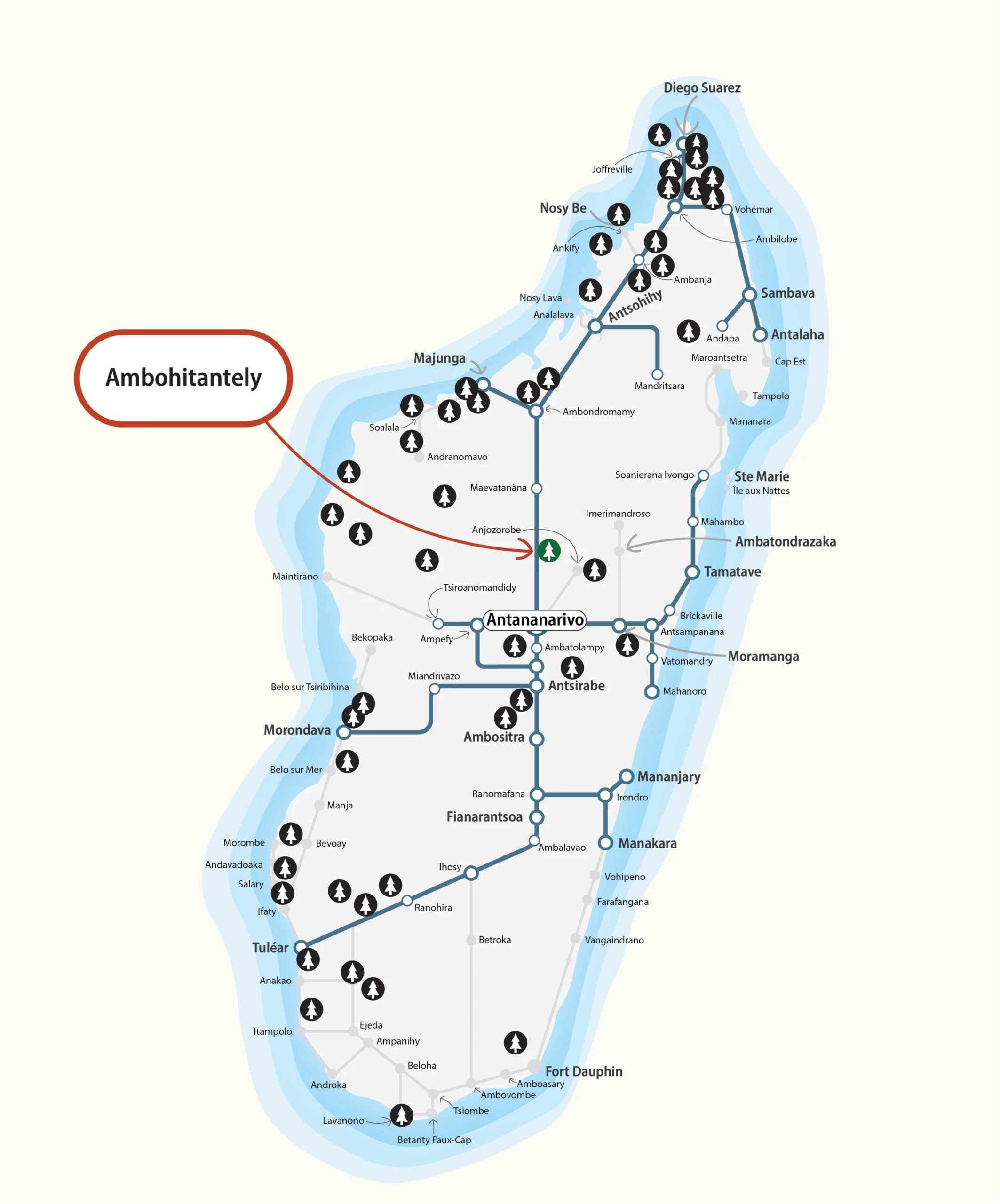
Special Reserve · Analamanga Region · Protected Areas of Madagascar · Highlands & Centre
Ambohitantely
Special Reserve
A fragmented remnant of the Central Highlands forest, where cool mist-laden ridgelines shelter rare orchids, three locally endemic amphibians, and a colony of cave-dwelling bats.
About the protected area
A highland forest remnant, fragmented but enduring
Ambohitantely Special Reserve is one of the Protected Areas of the Highlands and Centre of Madagascar. Established in 1982, it is managed by Madagascar National Parks.
The reserve is a remnant of the central plateau's original forest cover, situated 140 km north-west of Antananarivo, within the district of Ankazobe, Analamanga region. It straddles two rural communes, Antakavana-Andranomiady to the north-east and Ambolotarakely to the south-east, and covers the south-eastern portion of the Tampoketsa d'Ankazobe.
A campsite with a shelter tent, cooking area, water and sanitation is available, alongside a tourist trail leading to a viewpoint and a bat cave.
The manager's office is based in Andrinakely.
Infrastructure and Access
North-west of Antananarivo, via Firarazana
The Ambohitantely Special Reserve is located 140 km north-west of Antananarivo, in the district of Ankazobe, Analamanga region. A manager's office is based in Andrinakely.
The reserve offers a campsite with a shelter tent, a cooking area, water and sanitation, as well as a tourist trail leading to a viewpoint and a bat cave.
To reach the reserve, travel 30 km north of the town of Ankazobe, or 125 km from Antananarivo, to the village of Firarazana. From there, take the secondary road heading east for 12 km to reach the manager's office.
Fauna and Flora
A fragmented forest, three locally endemic amphibians
The reserve's climate is that of the Central Highlands, sub-humid in type. Rain falls between November and April. The cool season runs from June to August with a minimum temperature of 5.7 °C, while the hottest period extends from December to February with peaks of up to 29.3 °C.
The cool climate, combined with a six-month dry season and frequent morning mists, shapes the site's vegetation: a dense humid forest at medium altitude.
The Ambohitantely forest is heavily fragmented, broken into some 80 separate parcels. Secondary grassland covers 40% of the protected area's surface and separates the forested zones. The vegetation is dominated by Weinmannia rutenbergii (Cunoniaceae), Gymnosporia sp. (Celastraceae), Uapaca densifolia (Uapacaceae), Ravensara sp. (Lauraceae) and Diospyros sp. (Ebenaceae). In the valleys, palms (Dypsis spp., Arecaceae) and Pandanus sp. (Pandanaceae) are abundant. Several rare species of Orchidaceae and Polypodiaceae are nonetheless fairly common within the forest, while Erica sp. (Ericaceae) and Nastus sp. (Gramineae) dominate along the forest edges.
The reserve shelters 40 amphibian species, 5 lemur species, 25 reptile species, 14 tenrec species, and 87 bird species. Three amphibian species are locally endemic: Boophis andrangoloaka, Anilany helenae, and Anodonthyla vallani.
Culture and Socio-economic Practices
Sakalava royal tombs, and a tortoise under threat
Several cultural sites and monuments are found in and around the protected area. The first mosque is a Doany in the village of Baly. The tombs of the Sakalava kings are located at Bemosary. At Lavohazo, Sohihy trees are used in the construction of coffins, and the site hosts the annual Rangan-dolo festival and the cleaning of the royal tombs.
Ziziphus mauritiana is an invasive species at the site, which is further threatened by bush fires set to create new pastures, trafficking of the ploughshare tortoise, hunting, selective logging of trees and mangroves, and the gathering of tubers and honey.
Identified threats
Location
Central Highlands Madagascar, Analamanga Region
Ambohitantely Special Reserve lies 140 km north-west of Antananarivo, within the district of Ankazobe. The manager's office is based in Andrinakely. Access is via the village of Firarazana, then a 12-km secondary road heading east.