Harmonious Landscape · North-West Region · Protected Areas of Madagascar · North-West
Mahavavy Kinkony
Wetland Complex
A mosaic of lakes, mangroves and dry forest stretching across the north-west coast, home to 128 bird species, sacred Sakalava sites, and the second-largest lake in Madagascar.
About the protected area
Harmonious Landscape of the Mahavavy Kinkony Wetland Complex
The Harmonious Landscape of the Mahavavy Kinkony Wetland Complex is one of the Protected Areas of Madagascar in the North-West Region. Established in 2015, the site brings together the Tsiombikibo Classified Forest, designated in 1957, and the Lake Kinkony Site of Biological Interest, a former hunting reserve created in 1972. It is managed by Asity Madagascar.
Extending across 302,000 ha, the protected area encompasses Lake Kinkony, the second-largest lake in Madagascar, lying south of the town of Mitsinjo, along with its satellite lakes, the lower course and delta of the Mahavavy river, a maritime zone to the north, Marambitsy Bay to the west and Boeny Bay to the east, as well as the Tsiombikibo dry forest at its centre.
Infrastructure and Access
North-western Madagascar, via ferry from Mahajanga
To reach the site, take the ferry from Mahajanga to Katsepy, then follow the RNT19, also known as the RIP112, for 70 km to the village of Mitsinjo, 15 km from Namakia. Access by pirogue or motorboat can also be arranged from Mahajanga to the sites of Boeny Aranta or Ampitsopitsoka, or by pirogue from Namakia to Ampitsopitsoka.
The manager maintains an office in Mitsinjo, a liaison office at Makary on Lake Kinkony, and an information office at the site entrance in Androhibe.
Tourist infrastructure is available at Ampitsopitsoka, with privately managed bungalows and pirogue circuits through the Mahavavy delta for migratory and coastal bird observation. At Makary, bungalows and tent shelters are operated by the Vorofaly community association, with circuits for lakeside bird watching. At Boeny Aranta, bungalows and a gîte managed by the local community association offer varied circuits to the Antoheribory cultural site, dry forests, mangroves, and salt marshes.
Climate · Fauna and Flora
Heterogeneous wetland landscape, 128 bird species recorded
The climate follows the dry pattern typical of the North-West Region: a cool season from June to August with minimum temperatures of 17 °C, and a hot season from December to February peaking above 34.5 °C, with the rainy season running from November to April.
The site presents a heterogeneous landscape. The bays of Marambitsy and Boeny, together with the Mahavavy delta, are covered in mangroves. Tsiombikibo shelters a dense dry forest, with fragments at Makary, Ampitsopitsoka and Morafeno Kingana. The protected area also features riparian forest along the banks of the Mahavavy, while marshes occupy the eastern part of the river's course. Secondary formations and grasslands develop across further parts of the protected area.
The flora is characteristic of dry forest, including Dalbergia, Erythrophleum, and Bauhinia pervillena, alongside aquatic plant species.
Culture and Socio-economic Practices
Sakalava lands and sacred sites, a community under pressure
Agriculture, primarily rice cultivation, alongside livestock rearing and fishing form the main economic activities of the local population. The protected area is home to sacred Sakalava sites (Doany). Mitsinjo is the centre of the Marambitsy tribe, and several community events take place there each year.
The protected area faces a range of converging threats: intensive freshwater fishing, the conversion of marshes to rice paddies, bird hunting, bush fires, the logging of precious timber and mangrove trees, and overfishing. The spread of the invasive water hyacinth Eichhornia crassipes poses an additional and growing threat.
Identified threats
Location
North-western Madagascar, Boeny Region
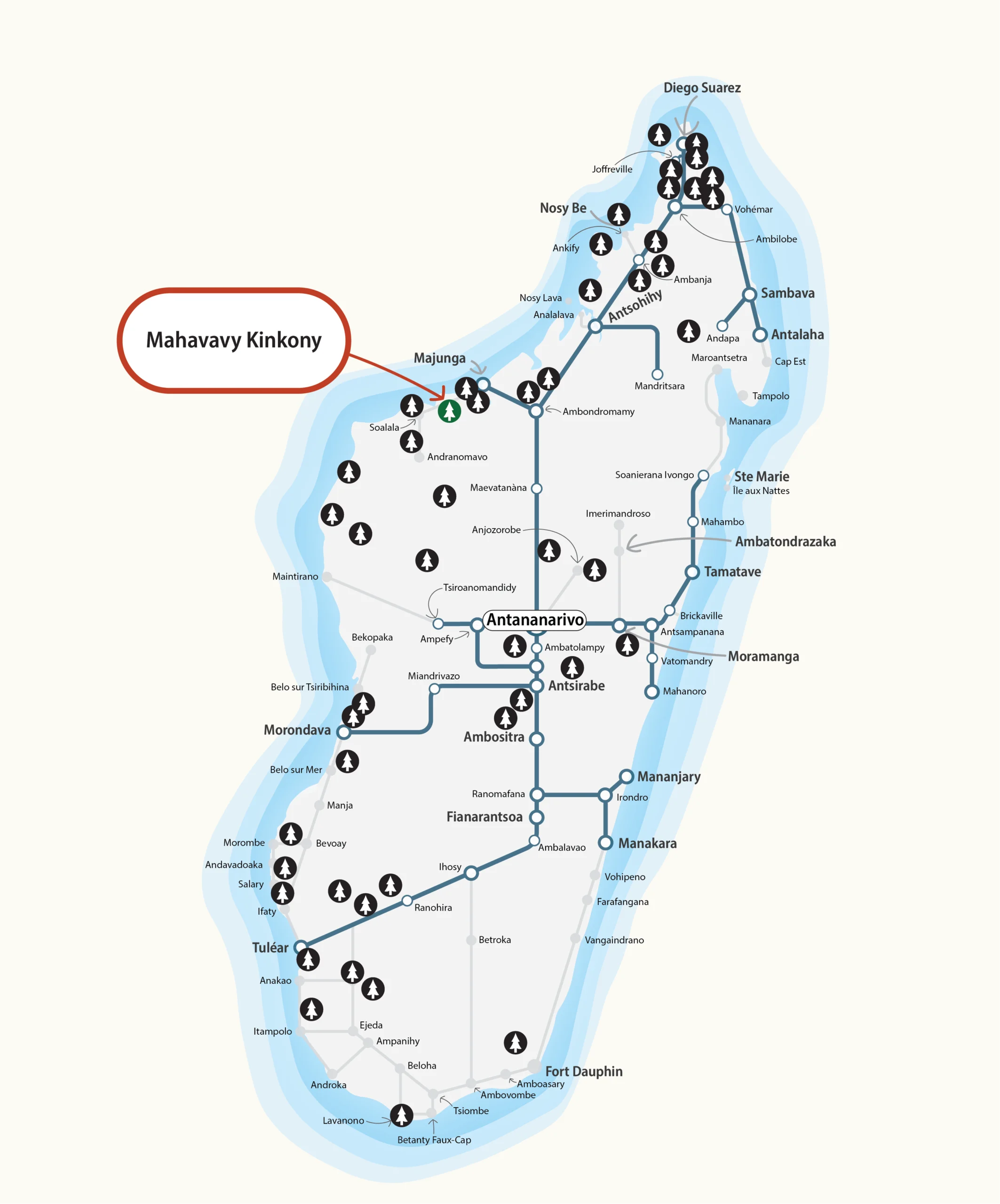
The Mahavavy Kinkony Wetland Complex lies along the north-west coast of Madagascar in the Boeny Region. The manager's office is based in Mitsinjo. Access from Mahajanga by ferry to Katsepy and then 70 km along the RNT19/RIP112, or by pirogue or motorboat directly to the lakeside and delta sites.