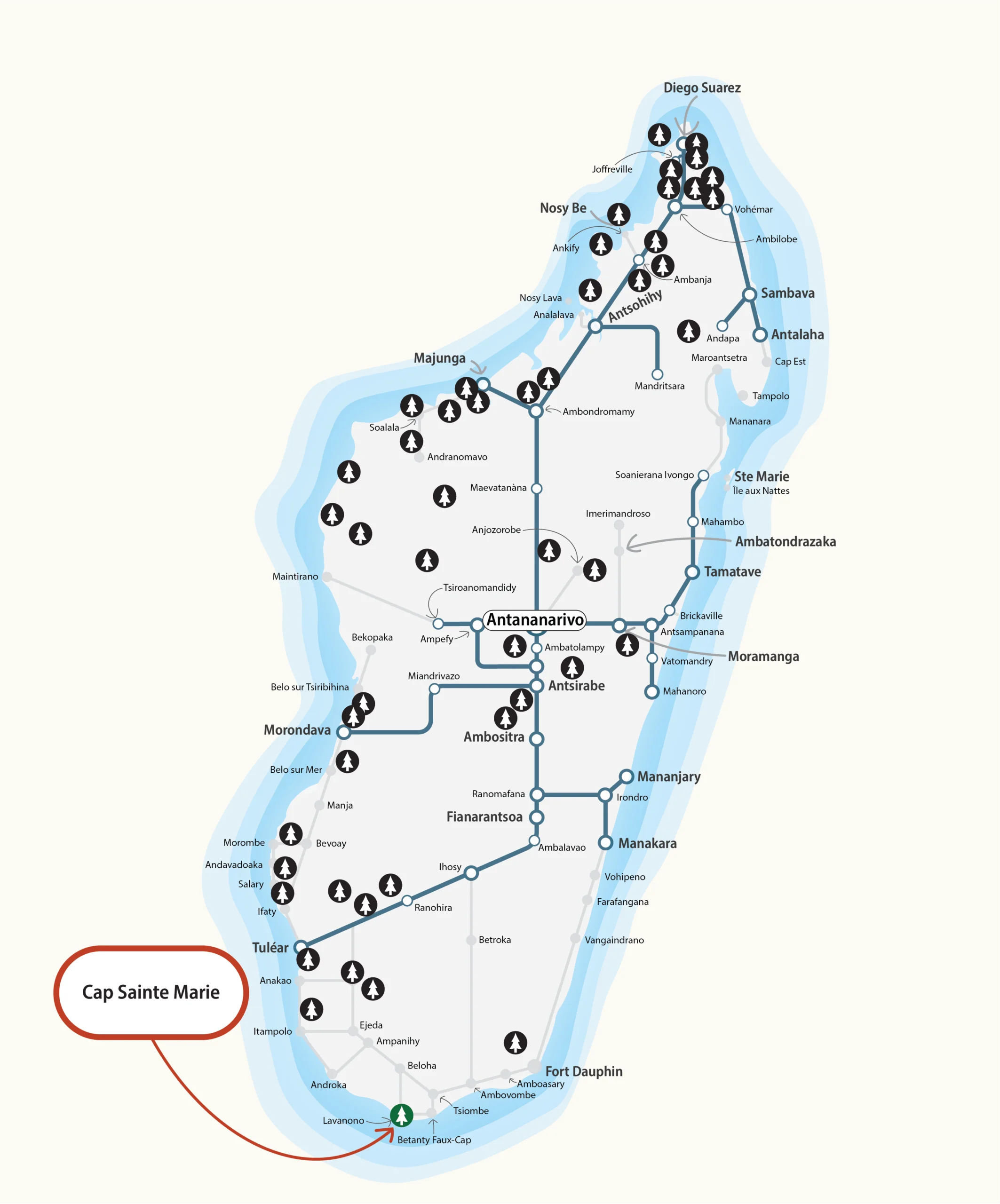
Special Reserve · South Region · Madagascar
Cap Sainte Marie
Special Reserve
The southernmost tip of Madagascar, a limestone plateau rising barely 200 m above a rugged coastline of cliffs, faults and ravines, sheltering spiny thicket, sacred sites, and a unique assemblage of reptiles, birds, and lemurs.
About the protected area
The southernmost tip of Madagascar, limestone plateau and spiny thicket
The Cap Sainte Marie Special Reserve, also known as Cap or Tanjona Vohimena, is one of the Protected Areas of Madagascar in the South Region. Created on 24 October 1962 and subject to a boundary revision in 2015, it covers 3,610 ha and is managed by Madagascar National Parks (MNP).
The reserve constitutes the southernmost point of Madagascar. It comprises a limestone plateau barely 200 m high, overlooking a rocky coastline composed of steep cliffs, faults, and ravines. The vegetation is characteristic of spiny thicket, with species including Alantsilodendron pilosum, Alluaudia comosa, Aloe millotii, Liliaceae, Megistostegium perrieri, and Malvaceae.
The MNP office in Tsihombe provides guiding services and access to the reserve. A visitor reception centre with a campsite (4 tent shelters, water, electricity, and sanitary facilities) is located at Bevazoa. A 3‑km tourist trail has been developed.
Infrastructure and Access
Southern Madagascar, via Tsihombe on RN10
The reserve is located 63 km from Tsihombe, on a secondary road that passes through the villages of Marovato, Ankavatritra, and Bevazoa. Access is from Tsihombe on the RN10, the main road connecting Tolagnaro and Toliara.
A visitor reception centre is located at Bevazoa, with a campsite equipped with 4 tent shelters, water, electricity, and sanitary facilities. A 3‑km tourist trail has been developed within the reserve. The MNP office in Tsihombe handles guiding and access arrangements.
Climate, Fauna and Flora
Arid climate year‑round, spiny thicket and coastal endemics
The climate is arid throughout the year. The cool season falls in June and August, with temperatures dropping to 12 °C. The hot season runs from December to February, with peaks exceeding 35 °C.
The vegetation is typical of spiny thicket, with species such as Alantsilodendron pilosum, Alluaudia comosa, Aloe millotii, Liliaceae, Megistostegium perrieri, and Malvaceae.
Fauna includes: 2 bird species, 1 Tenrecidae species, 2 lemur species, 2 species of land tortoise, 1 bat species, 1 reptile, and 1 amphibian.
Culture and Socio‑economic Practices
Sacred sites and spirit places, medicinal plants and threatened tortoises
The reserve contains several sacred sites, including places associated with spirits (Kokolampo) that are believed to cause disturbances and negative actions if disturbed. Tombs, especially around Vohimena and in surrounding areas, are also present.
The sacred rock Tsikinikitse is a site where the first inhabitants placed the umbilical cords of their children, reflecting deep cultural traditions.
The plant Operculicarya decaryi (Anacardiaceae, known as jabily or false pepper tree) is used for medicinal purposes and for making coffins. Radiated tortoises are overexploited, as is the plant Euphorbia stenoclada.
Identified threats
Location
Southernmost Madagascar, Cap Sainte Marie
Cap Sainte Marie Special Reserve forms the southernmost tip of Madagascar, a limestone plateau overlooking a rocky coastline of cliffs, faults, and ravines. Access is via Tsihombe on RN10, then 63 km by secondary road through Marovato, Ankavatritra, and Bevazoa.