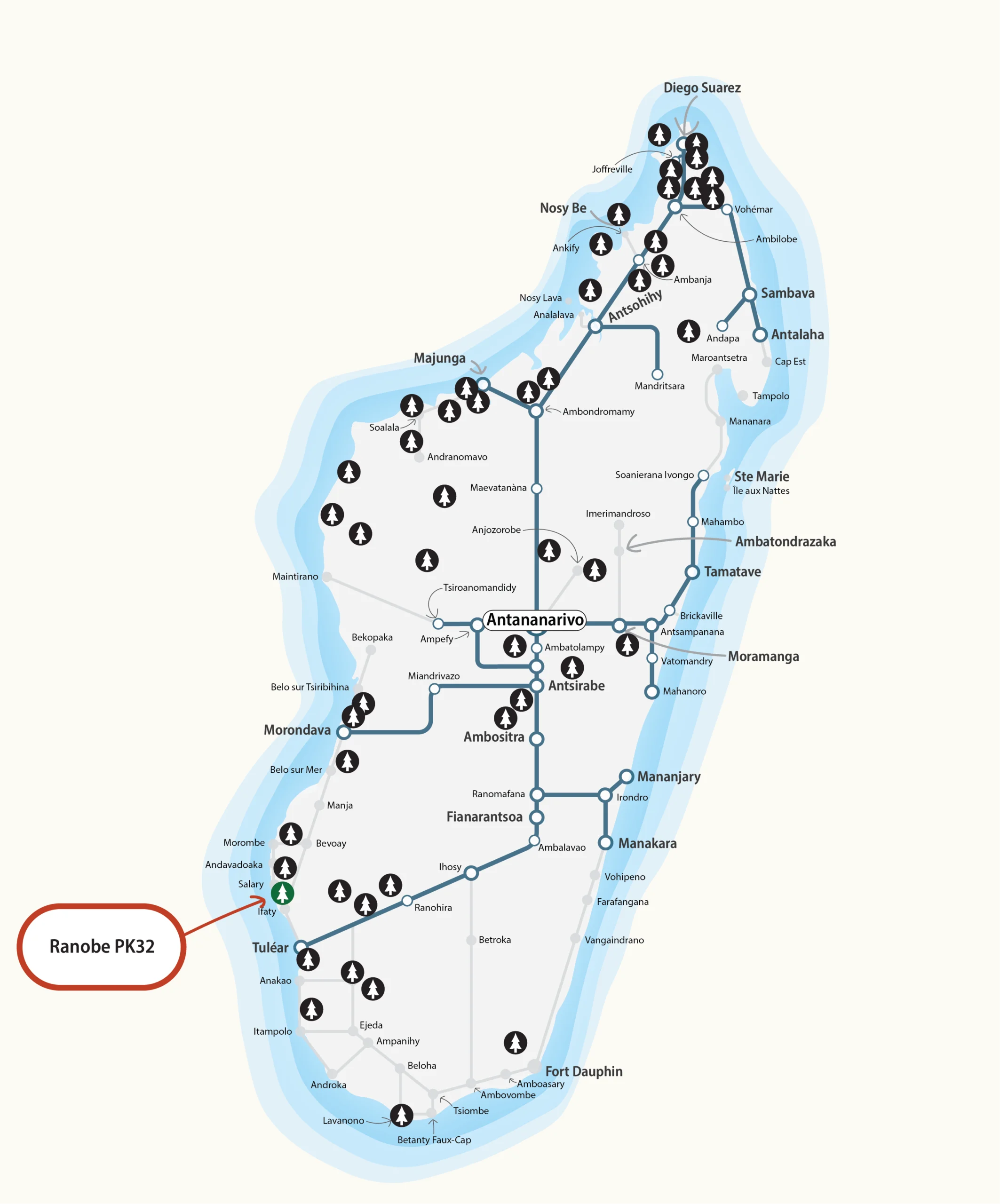
Protected Area · South Region · Madagascar
Ranobe PK32
Protected Area
A vast mosaic of coastal scrub, spiny thicket, dry forest, riparian woodland, freshwater lake and brackish wetlands, 32 km north of Toliara, sheltering 148 bird species and 42 reptiles in Madagascar's sub‑arid southwest.
About the protected area
A mosaic of dry forests and wetlands north of Toliara
The Ranobe PK32 Protected Area, also known as Forêt du PK 32, Ifaty Forest, or Belalanda Lake Complex, is one of the Protected Areas of Madagascar in the South Region. Created in 2015, it covers 168,500 ha and is managed by the Ministry of Environment, with its regional directorate based in Toliara.
The site is located 32 km north of Toliara on National Route 9, which connects Toliara to Morombe. It encompasses a remarkable diversity of habitats: coastal scrub on sand dunes, dry spiny thicket dominated by Didiereaceae, dense dry forest exceeding 15 m in height (with Adansonia za), riparian forest along the Manombo and Fiherenana rivers, a freshwater lake at Ranobe, and a network of brackish lakes and marshes at Belalanda.
Local management committees exist in the surrounding villages. Visit arrangements should be made through the regional directorate in Toliara or in consultation with these committees.
Infrastructure and Access
South‑west Madagascar, RN9 north of Toliara
The protected area is situated 32 km north of Toliara on National Route 9, the main road linking Toliara to Morombe. No detailed information on tourist infrastructure is available.
The regional directorate of the Ministry of Environment is based in Toliara. In addition, local management committees operate in the surrounding villages. Visitors are advised to contact the regional directorate or local committees for access and guidance.
Climate, Fauna and Flora
Sub‑arid southwest, diverse habitats and high endemism
The climate is sub‑arid, characteristic of south‑western Madagascar. The cool season runs from June to August, with temperatures dropping to 13.8 °C. The hot season extends from December to February, with peaks exceeding 34.3 °C (September to November). The rainy season lasts from November to April.
The vegetation is remarkably varied: coastal scrub on sand dunes, dry spiny thicket dominated by Didiereaceae, and dense dry forest exceeding 15 m in height (with Adansonia za). Riparian forest lines the Manombo and Fiherenana rivers, while a freshwater lake at Ranobe and a network of brackish lakes and marshes at Belalanda add further habitat diversity.
The flora includes 5 species of Didiereaceae, trees such as Boscia madagascariensis, and two baobab species: Adansonia rubrostipa and Adansonia za. The fauna is dominated by birds (148 species) and reptiles (42 species), with notable endemism.
Culture and Socio‑economic Practices
Forest clearing and charcoal production, 35.3% forest loss
Local communities surrounding the protected area rely on forest resources for their livelihoods. The main pressures on the reserve include forest clearing for agriculture and charcoal production, a key economic activity in the region.
Total forest cover loss within the protected area has been estimated at 35.3%, highlighting the urgent need for sustainable management and alternative livelihood support.
Identified threats
Location
South‑west Madagascar, north of Toliara
The Ranobe PK32 Protected Area is located 32 km north of Toliara along National Route 9, which connects Toliara to Morombe. The site encompasses coastal dunes, dry spiny forest, dense dry forest, riparian woodland, a freshwater lake, and brackish wetlands.