Strict Nature Reserve · DIANA Region · Protected Areas of Madagascar · North-West
Tsaratanàna
Strict Nature Reserve
The rooftop of Madagascar: a cloud-wreathed massif peaking at 2,876 m, sheltering 72 plant species found nowhere else on Earth and a mosaic of forest, bamboo, ericoid heath, peatbog and mountain lake.
About the protected area
Rooftop of Madagascar, closed to tourists
The Strict Nature Reserve of Tsaratanàna is one of the Protected Areas of Madagascar in the Northern Region. Established in 1927 and extended in 1966 as Strict Nature Reserve No. 4 (49,331 ha), it is managed by Madagascar National Parks. The reserve forms part of the Ambohimirahavavy–Marivorahona Protected Area Complex (CAPAM), which incorporated northern and southern extensions of the protected area totalling 59,279 ha.
Tsaratanàna is the highest point in Madagascar, with its summit Maromokotra reaching 2,876 m. The reserve straddles the convergence of three major watersheds: the Ramena, the Sambirano, and the northern Mahavavy.
The strict nature reserve is closed to tourists. Scientific access arrangements must be discussed directly at the manager's headquarters or at the Ambanja office.
The manager's office is based in Ambanja, with sector offices at Marotolana, Mangindrano, and Haute Ifasy Manambato.
Infrastructure and Access
North-western Madagascar, approached on foot
The reserve is situated in the north-western part of Madagascar, within the DIANA region. Entry points require substantial trekking with long ascents. There are two principal approaches.
From the south, access follows the RN31 between Antsohihy and Bealanana, then a secondary road between Bealanana and Ambatoriha through to Mangindrano. From the south-west, the route follows the RN4-12 from Ambanja via Marotolana and Beangona Ambevy, crossing the Sambirano river by boat. All entry routes involve extended hiking with significant elevation gain.
Fauna and Flora
Altitudinal zonation, 72 plant species found nowhere else
The climate is characterised by the sub-humid conditions typical of the northern part of Madagascar. The rainy season runs from November to April. The cool season extends from June to August with minimum temperatures of 5.4 °C, while the hottest period, December to February, sees peaks of up to 28.6 °C.
The vegetation follows a clear altitudinal sequence. Dense humid lowland forest occupies the north-western section of the reserve. Above 1,000 m this transitions to dense humid mid-altitude forest, with mountain lakes fringed by aquatic vegetation. Above 2,000 m, impenetrable bamboo thickets colonise areas where forest has been destroyed by fire or cyclones. The 6,000-ha summit plateau supports ericoid thicket, particularly on the western side, giving way to Erica grassland. Marshes, peatbogs, and small lakes are also found at altitude. The Mahavavy basin has been extensively cleared.
The flora includes 72 species known only from Tsaratanàna, among them Pandanus maromokotrotrensis(Pandanaceae), recorded at 1,700 m. Senecio tsaratananensis is a locally endemic species.
Culture and Socio-economic Practices
Sakalava and Tsimihety lands, sacred sites under pressure
The population surrounding the reserve is predominantly Sakalava and Tsimihety. The protected area contains several sacred sites of significance to local communities.
The reserve faces multiple converging pressures: deforestation, agriculture practised in forest undergrowth, hunting, extraction of precious hardwoods, and fire, notably fires associated with the cultivation of Cannabis sativa.
Identified threats
Location
North-western Madagascar, DIANA Region
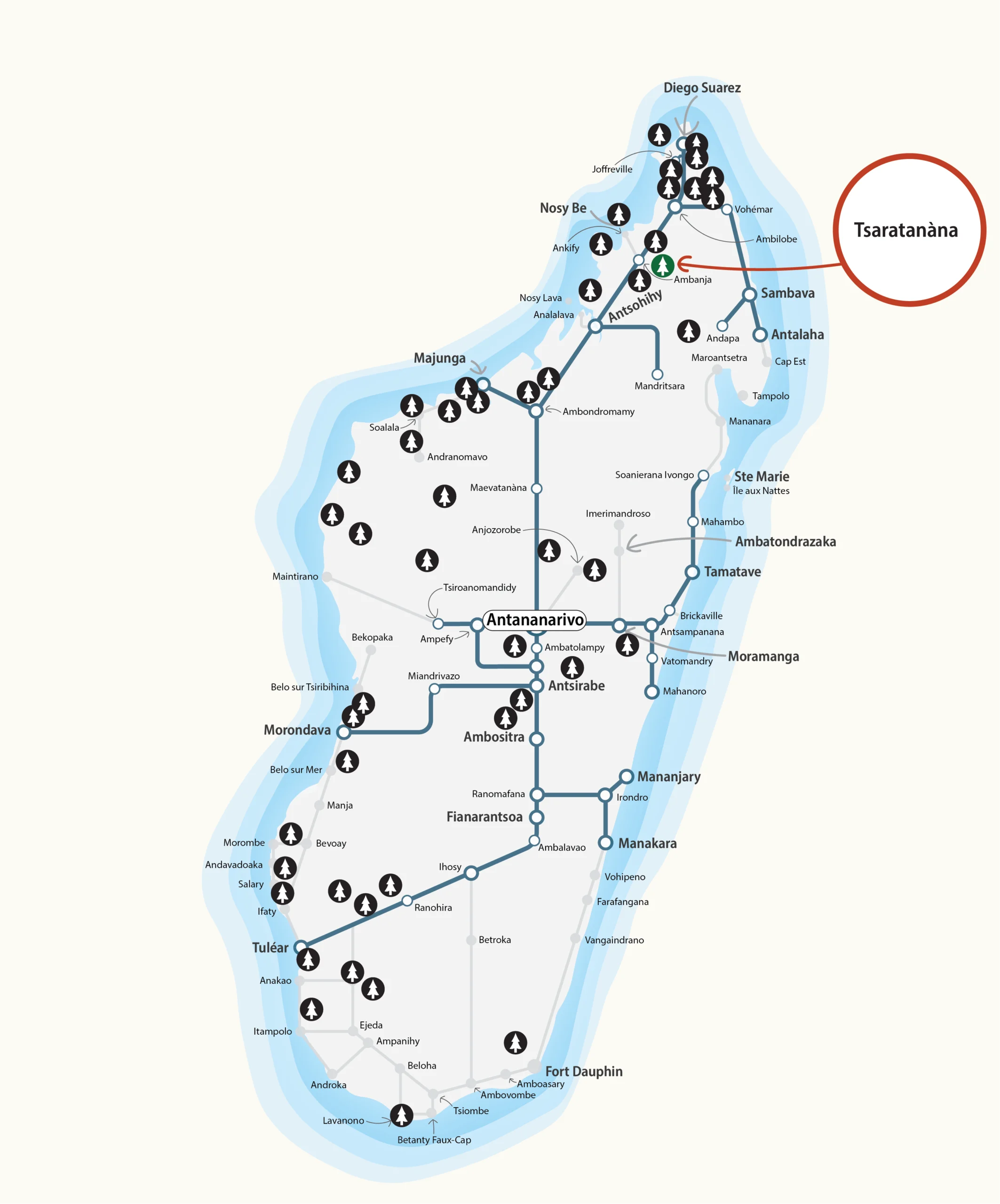
Tsaratanàna Strict Nature Reserve lies in the north-western part of Madagascar within the DIANA region. The manager's office is based in Ambanja. Entry from the south via the RN31 and Mangindrano, or from the south-west via the RN4-12 from Ambanja with a river crossing of the Sambirano.