National Park · Boeny Region · Protected Areas of Madagascar · North-West
Baie de Baly
National Park
A remote coastal sanctuary on Madagascar's north-west shore, where dry forest, bamboo thicket and mangrove delta shelter the last wild population of the ploughshare tortoise, the Angonoka.
About the protected area
A bay of dry forest, last refuge of the Angonoka
Baie de Baly National Park is one of the Protected Areas of Madagascar in the North-Western Region. Established in 1997, it is managed by Madagascar National Parks.
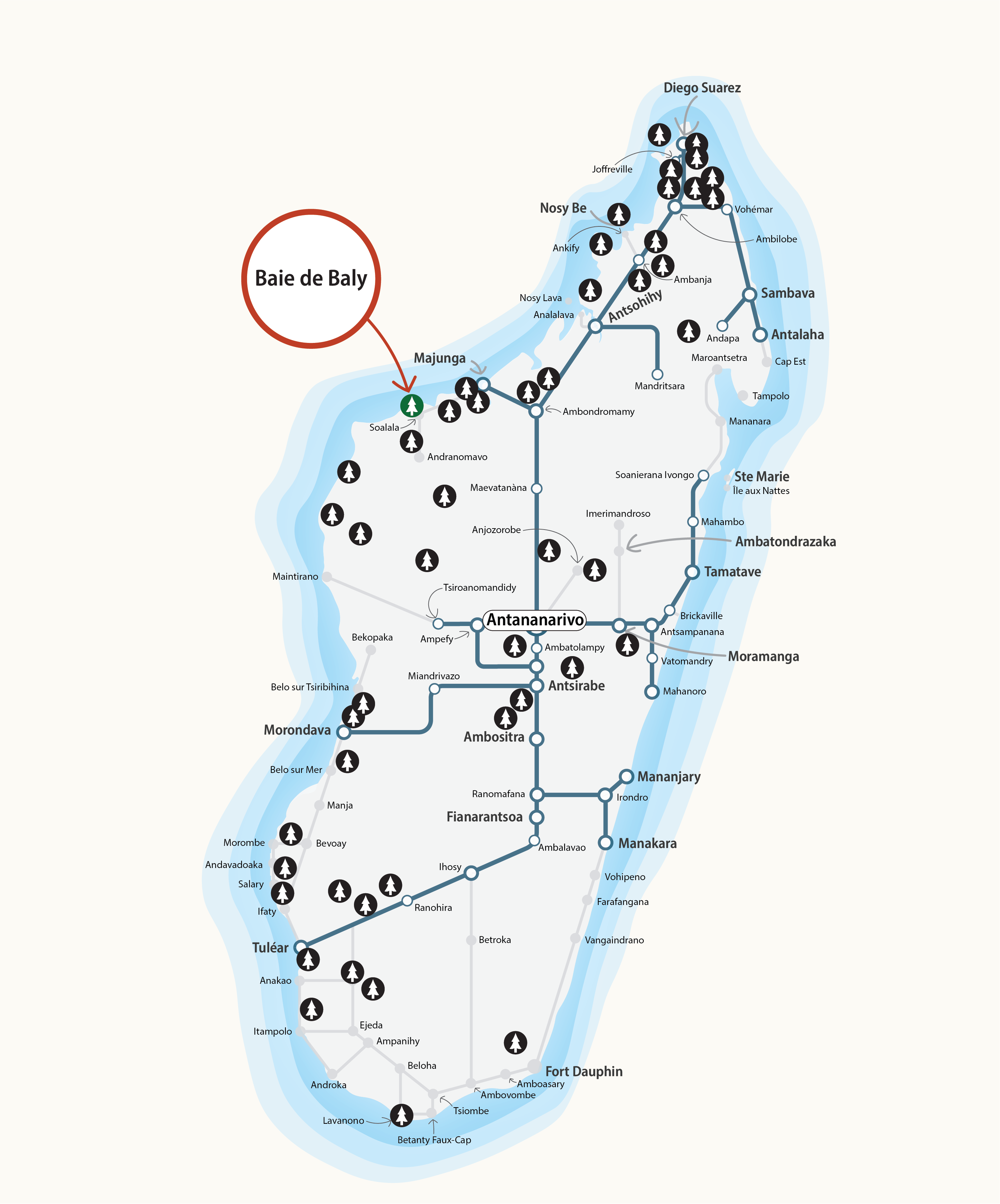
The park lies 150 km south-west of the city of Mahajanga, within the rural commune of Soalala.
There is no tourist infrastructure within the park. Visit and stay arrangements must be discussed directly with the manager, who maintains an office in Soalala.
The manager's office is based in Soalala, with four guard posts located at Antanandava, Antanandava II, Befotala, and Maroleo.
Infrastructure and Access
North-western coast, reached by boat and 4×4
Baie de Baly National Park is situated 150 km south-west of the city of Mahajanga, within the rural commune of Soalala.
The Baie de Baly is accessible by boat from Soalala. To reach Soalala, visitors must take the ferry from Mahajanga to Katsepy, then follow the RNT19 or the RIP112 connecting Katsepy to Soalala, a 150 km road journey taking around 8 hours by 4×4.
There is no tourist infrastructure within the park, though walking circuits are available. The terms of any visit or stay are to be discussed with the manager, who maintains an office in Soalala and four guard posts at Antanandava, Antanandava II, Befotala, and Maroleo.
Fauna and Flora
Dry forest and mangrove, home to the ploughshare tortoise
The park's climate is governed by the dry conditions typical of the north-western zone: a cool season runs from June to August with a minimum temperature of 16.7 °C, and a hot season from December to February peaks above 33.0 °C. The rainy season extends from November to April.
The Baie de Baly shelters a dense dry forest forming a large block across the western part of the protected area, with smaller, irregular patches in its southern section.
The south-western part of the Baie de Baly is largely covered by secondary thicket dominated by Perrierbambus madagascariensis (bamboo), the preferred habitat of Astrochelys yniphora, the ploughshare tortoise or "Angonoka." Grasslands and pastures have developed across the site, while marshes and peatbogs occur in the lake areas. Mangroves are found in the deltas and within the Baie de Baly itself.
The flora includes, among others, Adansonia rubrostipa, Astrotrichilia asterotricha, and Oeceoclades beravensis.
The bay shelters 112 bird species and 5 reptile species, including the locally endemic ploughshare tortoise, the "Angonoka."
Culture and Socio-economic Practices
Sakalava royal tombs, and a tortoise under threat
Several cultural sites and monuments are found in and around the protected area. The first mosque is a Doany in the village of Baly. The tombs of the Sakalava kings are located at Bemosary. At Lavohazo, Sohihy trees are used in the construction of coffins, and the site hosts the annual Rangan-dolo festival and the cleaning of the royal tombs.
Ziziphus mauritiana is an invasive species at the site, which is further threatened by bush fires set to create new pastures, trafficking of the ploughshare tortoise, hunting, selective logging of trees and mangroves, and the gathering of tubers and honey.
Identified threats
Location
North-western Madagascar, Boeny Region
Baie de Baly National Park lies 150 km south-west of Mahajanga, within the rural commune of Soalala. The manager's office is based in Soalala. Access is via the Mahajanga–Katsepy ferry, followed by road to Soalala, and finally by boat across the bay itself.