Special Reserve · Menabe Region · Protected Areas of Madagascar · South-West
Andranomena
Special Reserve
The southern frontier of the great Menabe Central forest block, a dry deciduous forest sheltering the world's smallest lemur and a rare flat-shelled tortoise, 30 km north of Morondava.
About the protected area
Southern Menabe Central forest, part of the Antimena landscape
The Andranomena Special Reserve is one of the Protected Areas of Madagascar in the Southern Region. Initiated in 1955 and formally created in 1958, it is managed by Madagascar National Parks (MNP). The reserve forms part of the Antimena Protected Harmonious Landscape while retaining its own distinct legal and land-tenure status.
Andranomena marks the southern boundary of the great Menabe Central forest block, one of the most ecologically significant dry deciduous forest systems in Madagascar. There are no hotel facilities on site. The two marked circuits, Andranohazo and Tsinjolavitra, together cover 3 km.
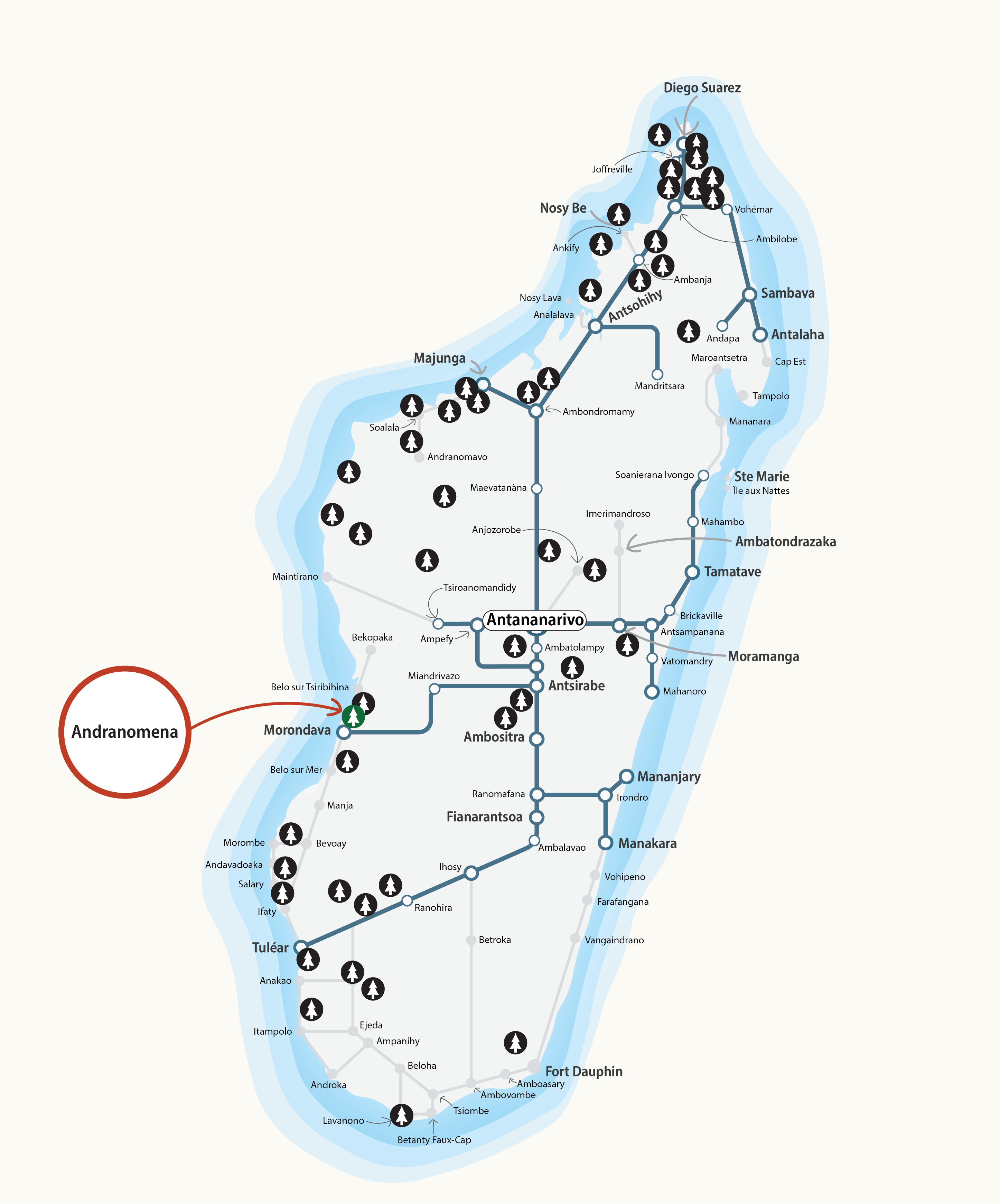
The reserve is accessible by road: take the RN35 from Morondava towards Marofototra (11 km), then turn north onto the RN8 for a further 15 km to reach Andranomena.
Infrastructure and Access
30 km north of Morondava, reached by paved road
Andranomena lies in south-western Madagascar within the Menabe region, 30 km north of the town of Morondava. The principal management complex is based in Belo-sur-Mer, with a liaison office in Morondava and an MNP bureau at the reserve entrance at Andranomena itself.
The reserve is straightforwardly accessible by road: from Morondava, follow the RN35 towards Marofototra (11 km), then head north on the RN8 for 15 km to the reserve entrance. Visit arrangements should be discussed at the on-site MNP bureau or at the Morondava liaison office.
Fauna and Flora
Dry deciduous forest, home to the world's smallest lemur
The climate is sub-arid south-western: a cool season from June to August with temperatures around 11.9 °C, a hot season from December to February peaking above 33.2 °C, and a rainy season between November and April.
The northern part of the reserve harbours dense dry deciduous forest, a habitat for plant species heavily exploited by local communities, as well as for carnivorous mammals, rodents, and lemurs. Temporary lakes (ranovory) attract waterbirds. The central and southern zones present more degraded forest forms, with temporary lakes surrounded by grassy marshland. The southern boundary is defined by secondary forest and scrub patches sheltering several sacred baobabs.
Andranomena is notable for two species of particular conservation significance: the flat-shelled spider tortoise Pyxis planicauda, a critically endangered endemic reptile, and Microcebus berthae, Madame Berthe's mouse lemur, the world's smallest primate.
Culture and Socio-economic Practices
Dry forest under pressure, 13.5% of cover already lost
The reserve faces several converging pressures from surrounding communities. Bushfires are set to clear land for cultivation, slash-and-burn agriculture encroaches on forest margins, and stolen livestock is concealed within the reserve. Illegal felling of precious hardwoods represents a further ongoing threat.
The cumulative impact of these pressures is measurable: 13.5% of the reserve's forest cover has already been lost.
Identified threats
Location
South-western Madagascar, Menabe Region
Andranomena Special Reserve lies 30 km north of Morondava, accessible by the RN35 then the RN8. The MNP bureau is situated at the reserve entrance; the Morondava liaison office provides visitor information.