Harmonious Protected Landscape · Amoron'i Mania Region · Protected Areas of the Highlands and Central Madagascar
Itremo Massif
Harmonious Protected Landscape
A highland sanctuary of sclerophyllous forests, rocky outcrops, and rare Aloe species in the heart of Madagascar's central plateau, managed in partnership with the Royal Botanic Gardens, Kew.
About the Protected Area
A highland sanctuary, open to visitors
The Itremo Massif Harmonious Protected Landscape covers 24,788 hectares in the Ambatofinandrahana district, within the Amoron'i Mania region of Madagascar's central highlands. Established in 2015, it incorporates part of the Itremo Classified Forest created in 1962 (13,102 ha), and is co-managed by the Royal Botanic Gardens, Kew. Further information on protected areas in Madagascar can be found at Maison de Madagascar.
The manager maintains an office in Antananarivo and two operational bureaux at Ihazofotsy and Amborompotsy. Visitor infrastructure includes a gîte at Itremo and another under construction at Ihazofotsy, two campsites at Ianasana and Analamanitra, and two bivouac areas at Antsirakambiaty and Maizinatoandro, the latter two also featuring marked tourist circuits. Visit and stay arrangements should be discussed with local guides at the site entrance.
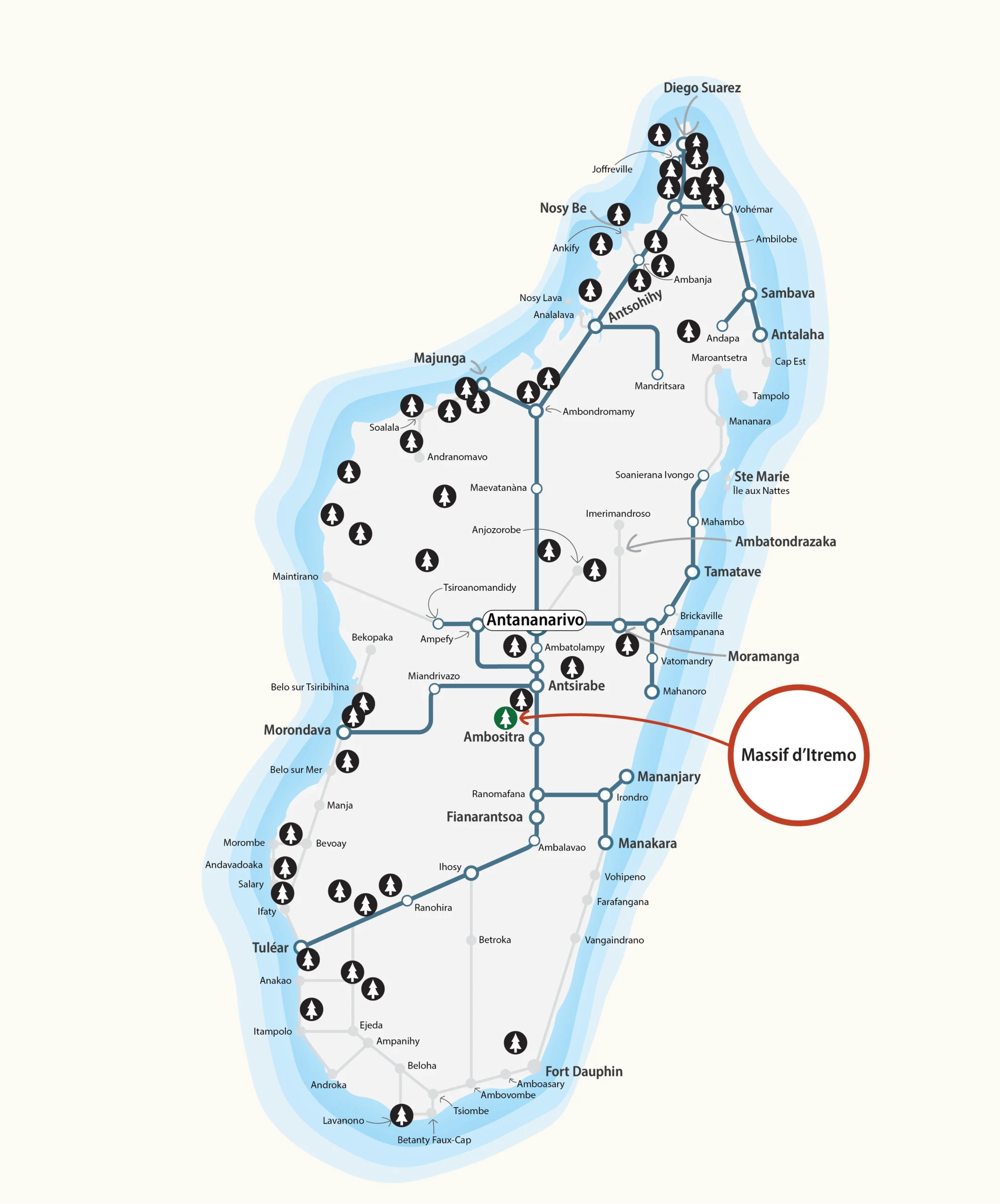
Access is via the RN7 to the village of Ivato, 15 km from Ambositra. Take the RN35 for 64 km to Ambatofinandrahana, then continue 40 km to the village of Itremo, where the Kew Madagascar office can facilitate site access.
Fauna and Flora
Sclerophyllous forest and gorges, endemic at every turn
The protected area experiences a climate characteristic of the subhumid Central Highlands, with a rainy season from November to April. The coldest months run from June to August, when temperatures can drop to 5.9 °C, while the warmest period is December to February, though temperatures may reach 31.1 °C between September and November.
The Itremo Massif is composed of two distinct sections. The western portion forms an ellipsoid massif cut by gorges, while to the east, three ridges dominate a Y-shaped valley system. Vegetation consists of degraded sclerophyllous forest dominated by Uapaca bojeri and Sarcolaena oblongifolia, along with rupiculous vegetation, xerophyte grasslands, and extensive stands of pine.
The flora is particularly rich in Aloe species (Asphodelaceae), 21 in total, as well as geophytes and resurrection plants. Fourteen plant species are endemic to the protected area, including three Aloe species: A. bellatula, A. cyrtophylla, and A. hoffmannii.
For fauna, the massif harbours one site-endemic species: the gecko Lygodactylus pauliani. A second gecko, Paroedura ibityensis, is endemic to the broader region. The protected area also supports 5 bird species, 17 amphibian species, 14 reptile species, and 2 lemur species (Microcebus sp. and Propithecus verreauxi).
Culture and Socio-Economic Practices
Betsileo heritage and the Vazimba ancestors
The Betsileo people are the predominant community in and around the site. Their livelihoods combine extensive zebu cattle-raising (with herds grazed freely across the Itremo grasslands), agriculture, small-scale mining, and the use of natural resources from the protected area.
The localities of Ianasana and Antsikarambiaty are traditionally held to have been inhabited by the vazimba, considered the ancestral founders of the Malagasy people. The site observes taboos (fady) on pigs, goats, and lemurs. Certain woody plants, Xerochlamys (Leptolaena), are harvested for the production of rum.
The main pressures on the protected area include fire, extensive livestock grazing (animals left free within the PA for four to five months), and extraction of precious and semi-precious stones and rock crystal. The collection of plants such as Borocera cajani and Euphorbia itremensis, and animals such as Mantella cowani, for trade, traditional medicine, or handicrafts also places significant strain on biodiversity.
Pine trees planted during the colonial period have become an invasive species, negatively affecting native forest and lowland flora, including terrestrial orchids.
Identified threats
Location
Central Madagascar, Amoron'i Mania Region
The Itremo Massif lies in the Ambatofinandrahana district, accessible from Antananarivo via the RN7 to Ambositra, then the RN35 south to Ambatofinandrahana, and onward 40 km to Itremo village where the Kew Madagascar office is located.