National Park · Nosy Be Island · DIANA Region · Protected Areas of Madagascar
Lokobe
National Park
The last remaining original forest of Nosy Be: a Sambirano rainforest fragment of 862 hectares sheltering the black lemur and endemic species found nowhere else on Earth.
About the protected area
The last original forest of Nosy Be
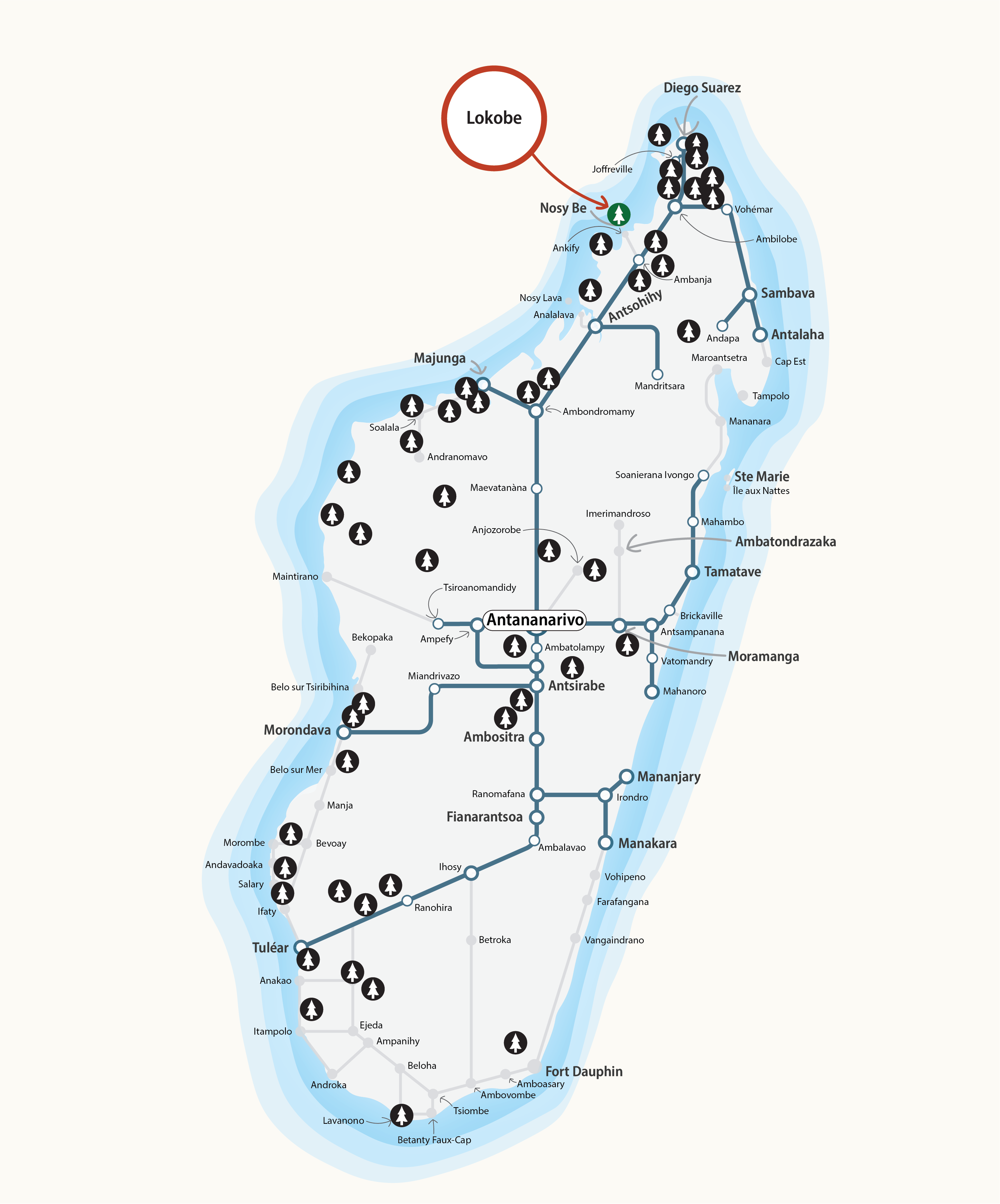
Lokobe National Park occupies the south-eastern part of the island of Nosy Be, located in the north-west of Madagascar in the DIANA Region. Originally established in 1927 as Strict Nature Reserve No. 6, it was redesignated as a national park in 2011 with revised boundaries, covering 740 hectares of terrestrial habitat and 122 hectares of marine zone. It is managed by Madagascar National Parks.
The manager maintains an office at Ambalafary, supplemented by a guard post to the east and a control barrier at Ambalafary. Tourist infrastructure includes an interpretation centre with a welcome desk at Ambanoro and a campsite with six tent places. Visit and guiding arrangements are to be discussed with guides at the site entrance.
Lokobe is one of the very few sites in Madagascar where the original Sambirano forest survives, and the only remaining primary forest on the island of Nosy Be itself.
Fauna and Flora
Intact Sambirano canopy, endemic at every level
The forest cover at Lokobe remains largely intact. Valley bottoms and slopes support Canarium and Parkia madagascariensis, while the ridges carry Diospyros clusiifolia, Uapaca ambanjensis, and Garcinia. Four palm species are present, including Dypsis ampasidavae. Secondary forest covers parts of the north-west and south, and remnant coastal mangrove survives along the shoreline alongside Terminalia catappa, Barringtonia asiatica, Heritiera littoralis, Ravenala madagascariensis, and the climbing liana Cissus.
The flora includes species endemic to the Sambirano domain, among them Potameia antevaratra. Eleven species are known only from Lokobe, with five known solely from their type specimen: Lasiocladus rufopilus, Dypsis nossibensis, Canarium madagascariense, Eugenia nosibensis, Mimusops nossibeensis, and Peperomia loucoubeana.
Culture and Heritage
Sakalava, Antakarana and the sacred forest
The dominant communities around the park are the Sakalava and the Antakarana. The protected area harbours several sacred sites connected to the Joro, the ancestral cult practised through zebu sacrifice, as well as to the purification bathing rites performed at the new moon, known as Fisehagna. These traditions reflect a deep, enduring relationship between the local communities and the forest they have long regarded as a living spiritual space.
Logging is the primary pressure faced by Lokobe National Park, threatening the integrity of the last primary forest remaining on the island of Nosy Be.
Identified threats
Tourist circuits
Three trails through forest, summit and shore
The park offers three circuits totalling around 7.5 km. Each offers a distinct experience, from dense forest loops to a summit climb and a coastal beach trail. Visit and guiding arrangements are to be discussed with guides at the site entrance.
-
Kindro Circuit
3 km
Forest loops of Ampasindava and Nosy Be -
Mitsinjo Circuit
1.5 km
1 km stairway climb to the Mitsinjo summit at 432 m altitude -
Ramy Circuit
3 km
Coastal trail along beaches with picnic opportunities
Location
North-west Madagascar, island of Nosy Be
Lokobe National Park occupies the south-eastern corner of Nosy Be island in the DIANA Region. The park is reached from Hell-Ville (Andoany) via the road to Ambanoro, with the manager's office at Ambalafary and the interpretation centre at Ambanoro.