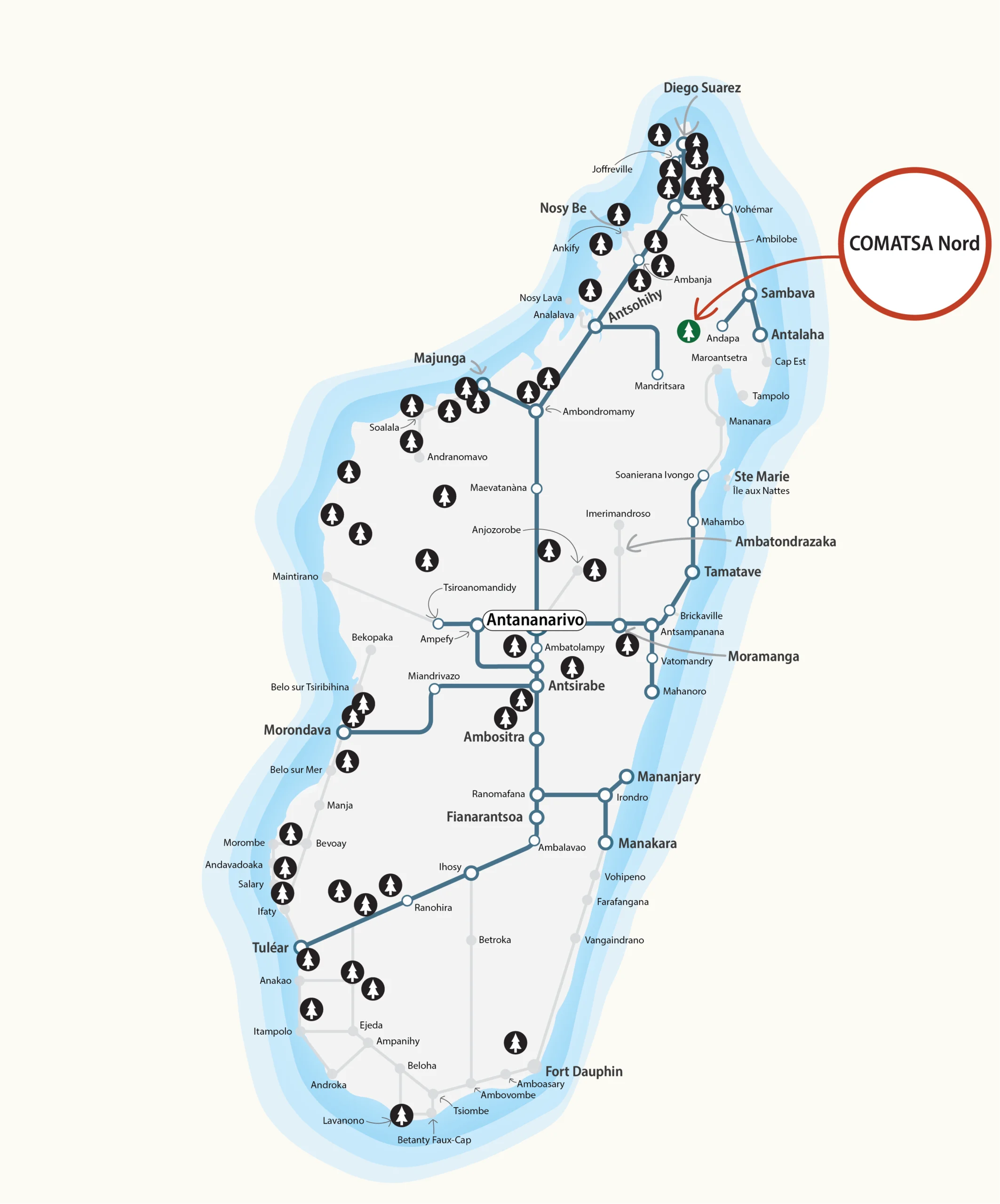
Natural Resource Reserve · SAVA · SOFIA · DIANA Regions · Protected Areas of Madagascar · North
COMATSA Nord
Natural Resource Reserve
A vast montane corridor spanning the ridgeline between the Indian Ocean and the Mozambique Channel, sheltering endemic amphibians, nine lemur species, and cloud forests found nowhere else on Earth.
About the protected area
Mountain corridor reserve, part of a vast complex
The Natural Resource Reserve of the Marojejy Anjanaharibe Sud Tsaratanàna Corridor, Northern Section, known as COMATSA Nord, is one of the Protected Areas of Madagascar in the Northern Region. Created in 2015, it incorporates two previously classified forests: the Andranovory Classified Forest (1961, 29,280 ha) and the Ambohimirahavavy Classified Forest (1962, 68,500 ha). Together, these form the natural resource reserve that constitutes part of the Ambohimirahavavy–Marivorahona Protected Area Complex (CAPAM), the second largest terrestrial protected area in Madagascar.
The reserve is managed by the World Wide Fund for Nature (WWF), which maintains an office in Andapa and a liaison office in Bealanana. The 32 community-based co-management bureaux distributed around the perimeter of the site, including those overseeing COMATSA Sud, play a central role in the governance of this landscape.
There are no tourist facilities within the reserve. Visit and stay arrangements must be discussed directly with the manager at the principal office in Andapa.
Infrastructure and Access
Northern Madagascar, accessible by moto and bush taxi
COMATSA Nord lies north of Andapa in the north-eastern part of the island, spanning the SAVA, SOFIA, and DIANA regions. The protected area occupies the main ridgeline that forms the watershed between the Indian Ocean and the Mozambique Channel, extending along the mountain chain that includes the Sorata and Andravory massifs eastward.
There is no regular road access. The south-eastern side is reachable via Doany (by motorbike), the western side via Ambatoriha (Bealanana) by bush taxi, and the north-eastern side via Milanoa (by bush taxi) during the dry season.
The manager's bureau in Andapa serves as the main point of contact. There are no tourism facilities on site; all visit arrangements should be coordinated in advance with the manager.
Fauna and Flora
Sub-humid montane forest, endemic at every turn
The climate of the reserve is dominated by the sub-humid conditions typical of the northern part of the island. The rainy season runs from November to April. The cool season extends from June to August with minimum temperatures of 6.7 °C, while the hottest period, December to February, sees temperatures peaking at up to 28.6 °C.
The reserve comprises dense humid forest at low and mid altitude, together with ericoid thicket. The site supports species from humid forest, from the northern mountain chains, and locally endemic taxa. On the upper watersheds of the Bemarivo and Bemafo rivers in the north-east, and on the eastern flanks of the Ambatomirarahavavy, the forest is homogeneous on ridges but more sparse on slopes, where liana-bamboos colonise the hillsides. Ericoid thicket is confined to the summits and is particularly abundant north of the central section of the reserve.
Six plant species are known only from COMATSA Nord: Cynanchum moratii (Apocynaceae), Elaphoglossum capuronii (Dryopteridaceae), Syzygium aurantiacum (Myrtaceae), Cynorkis humbertii and Disperis ciliata (Orchidaceae), and Schismatoclada purpurea (Rubiaceae).
Culture and Socio-economic Practices
Sacred forests, ancestral rituals and forest pressures
Several areas of the site contain sacred forests reserved for various rituals, including the Joro ceremony and the turning of the dead (famadihana). The reserve also encompasses several funerary sites of cultural significance to local communities.
Forest exploitation in all its forms exerts pressure on the reserve: livestock grazing, mining activity, collection of forest products, and commercial timber extraction. Slash-and-burn shifting agriculture is the principal threat, with farmers encroaching on the dense humid forests of the eastern portion of the site.
The forest understorey is exploited for vanilla cultivation. Significant areas have been cleared to grow Kat (Catha edulis), a psychoactive plant highly sought after by young people and men. Hunting of large birds such as Lophotibis cristata, the various Coua species, and tenrecs also represents a notable pressure on the reserve's fauna.
Identified threats
Location
Northern Madagascar, SAVA · SOFIA · DIANA Regions
COMATSA Nord lies north of Andapa in the north-eastern part of Madagascar, occupying the main mountain ridgeline that separates the Indian Ocean and Mozambique Channel watersheds. The manager's principal office is located in Andapa, with a liaison office in Bealanana.