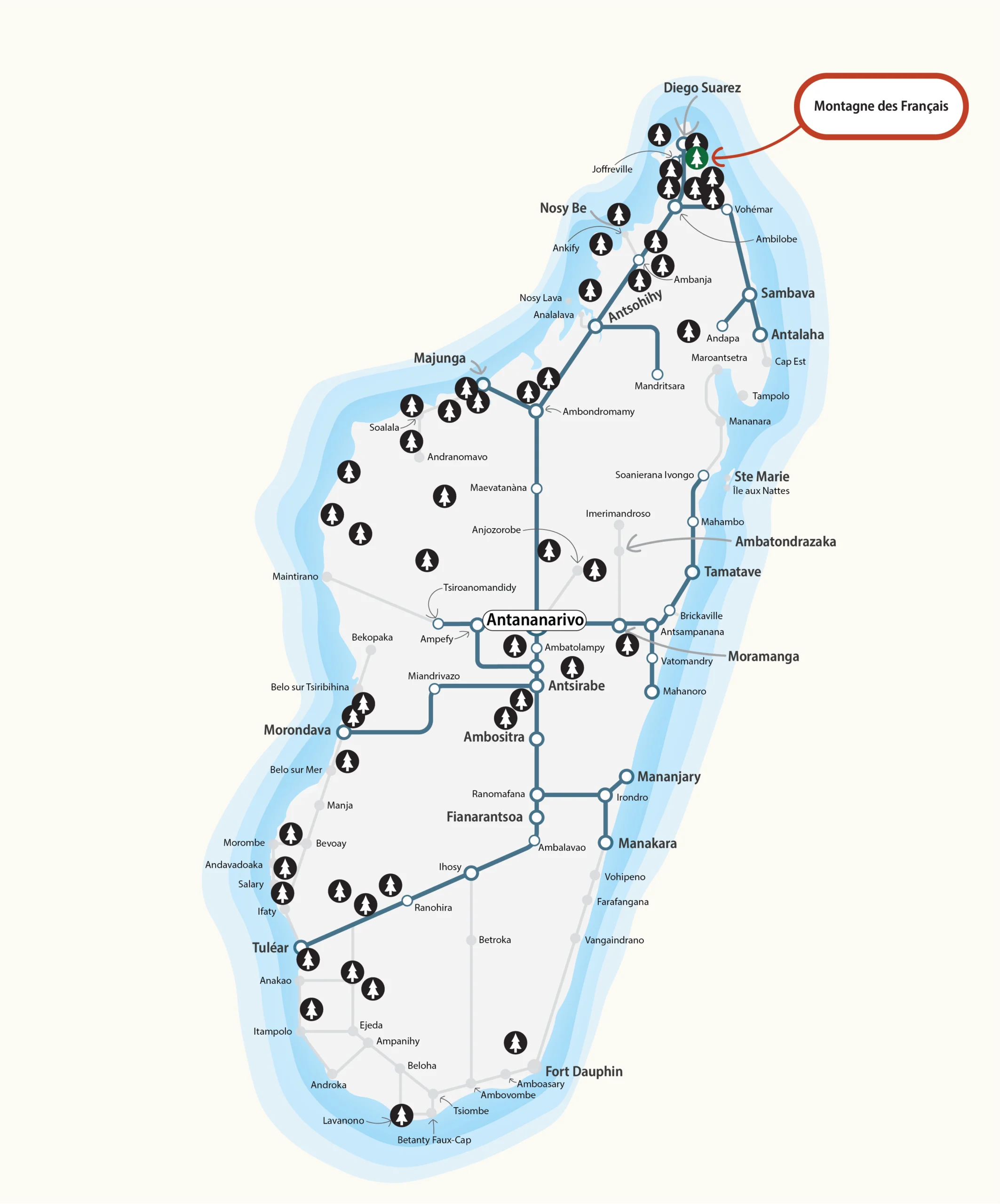
Harmonious Protected Landscape · DIANA Region · Protected Areas of Madagascar · Far North
Ambohitr'Antsingy
Montagne des Français
A fortified limestone massif above Diégo-Suarez, named for the French troops garrisoned here in the twentieth century, sheltering 13 plant species found nowhere else and Madagascar's oldest known traces of human presence.
About the protected area
A French garrison's heights, now open to visitors
The Ambohitr'Antsingy Montagne des Français Harmonious Protected Landscape is one of the Protected Areas of Madagascar in the Northern Region. Covering 6,049 ha, it was created in 2015 and is managed by the Service d'Appui à la Gestion de l'Environnement (SAGE).
The protected area owes its name to the occupation of the site by French troops during the twentieth century. It forms one of the forest massifs of the Far North of Madagascar, lying 7 km east of the town of Diégo-Suarez (Antsiranana).
Stone tools recently uncovered on the massif have been attributed to Neolithic peoples, making this Madagascar's oldest known archaeological site.
The manager's office is based in Antsiranana.
Infrastructure and Access
Forts and footpaths, without a roof to sleep under
Tourist infrastructure is located along the road linking Antsiranana and Ramena, and comprises a reception office and an interpretation centre with a botanical garden. The site has no accommodation infrastructure of its own.
Two tourist circuits are on offer. The Anosiravo circuit, 6 km long, leads to the colonial fort of the same name and is equipped with a rest area, stairways cut through tunnels, and two panoramic terraces. The other, known as the Grand Tour, runs from Mahagaga to Fort Ambohimarina and takes three hours via its stairways.
Further footpaths wind through the Baobab, Orchid and Parrot valleys, with 100 climbing routes for those equipped for it. Visit arrangements are to be discussed with guides at the site entrance, at Mahagaga, or at the Regional Tourism Office in Antsiranana.
Fauna and Flora
Dry forest on limestone, 13 plants found nowhere else
The protected area's climate follows the dry pattern typical of northern Madagascar. The rainy season runs from November to April. The cool season extends from June to August, with a minimum temperature of 17.9 °C, while the hottest period, from December to February, brings peaks of up to 34.1 °C.
The landscape is shaped by a dense dry forest of a distinctive form growing on limestone, home to species such as Celtis madagascariensis and the endemic Commiphora elliptica, alongside patches of semi-deciduous dense humid forest.
Thirteen plant species are known only from Montagne des Français, among them Beguea borealis, Echolium palmatum, Eugenia calciscopulorum, Euphorbia aureoviridiflora, Kalanchoe suarezensis, Scolopia calcicola, Carlephyton diegoense, Croton aleuritoides, Senna suarezensis, Dombeya ambohitrensis, D. milleri, Helmiopsiella poissonii, Warneckea peculiaris and Noronhia obcordifolia.
The fauna includes 10 amphibian species, one of them endemic — Stumpffia stafford — alongside 52 reptile species such as Brookesia tristis, Paroedura hordiesi and Heteroliodon fohy, 75 bird species, 10 bat species and 4 lemur species. Two fish-scale gecko species of the genus Geckolepis are still awaiting formal description.
Culture and Socio-economic Practices
Madagascar's oldest site, tools of the Neolithic
Montagne des Français is the oldest known archaeological site in Madagascar. Stone tool remains discovered there in recent years have been attributed to Neolithic peoples.
Location
Far North Madagascar, above Diégo-Suarez
The Ambohitr'Antsingy Montagne des Français Harmonious Protected Landscape lies 7 km east of the town of Diégo-Suarez (Antsiranana), within the DIANA region. The manager's office is based in Antsiranana, and the site is reached via the road linking Antsiranana and Ramena.