Special Reserve · Hauts‑Plateaux & Central Madagascar · Protected Areas
Ambohijanahary
Special Reserve
The last forest block in the central part of the island, covering the western edge of the Central Highlands. A refuge of sub‑humid and dry forest, sheltering a rich though threatened assemblage of amphibians, reptiles, and birds.
About the protected area
A last forest block in the central highlands, sub‑humid and dry
The Ambohijanahary Special Reserve is part of the Protected Areas of the Hauts‑Plateaux and Central Madagascar. Created in October 1958, it covers 24,750 ha and is managed by SEDIM (Sauvegarde de l'Environnement et Développement Intégré de Madagascar).
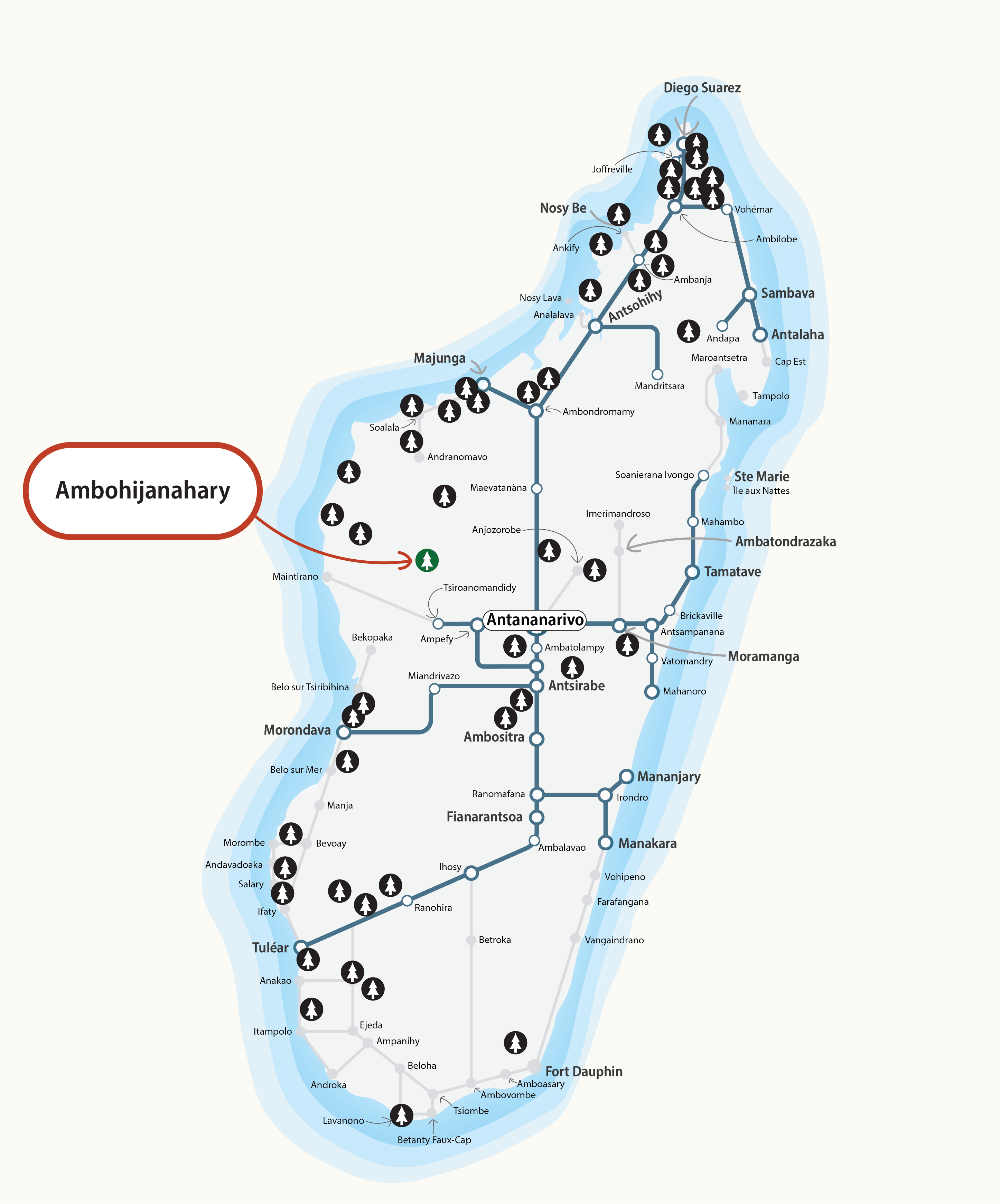
Ambohijanahary represents the last substantial forest block in the central part of the island, covering the western portion of the Central Highlands. It lies 130 km west of Tsiroanomandidy and 47 km from the village of Ambaravaranala, near the RN1bis or RNC195.
The reserve has no tourist infrastructure. All visits must be arranged directly with the manager's office in Tsiroanomandidy.
The manager's principal office is located in Tsiroanomandidy. No on‑site accommodation or visitor facilities are available within the reserve.
Infrastructure and Access
Central Highlands, western approach
Ambohijanahary is situated 130 km west of Tsiroanomandidy, near the RN1bis or RNC195, and 47 km from the village of Ambaravaranala. The reserve is the last remaining forest block in the central part of Madagascar.
Access is via the RN1bis or RNC195. The manager's office in Tsiroanomandidy should be contacted prior to any visit. There is no tourist infrastructure, and visitors must make their own arrangements for accommodation and supplies.
Climate, Fauna and Flora
Sub‑humid highlands with dry‑season extremes, two forest types
The climate is typical of the sub‑humid Central Highlands, but also shows characteristics of the dry climate of the far west. Rain falls from November to April. The cool season runs from June to August, with minimum temperatures of 9.5 °C; the hottest period, December to February, sees peaks of up to 29.7 °C.
The forests of Ambohijanahary are western extensions of the humid domain. Two main forest types occupy the reserve: dense low‑lying forest with species such as Ocotea, Erythroxydum sphaeranthum, Syzygium, Ilex mitis, Cyathea, and Aphloia; and open forest, which is a secondary forest in the process of regeneration. The remainder of the reserve is covered by grassland or secondary pastures.
The fauna is relatively modest but significant: 17 amphibian species, 13 reptiles, 55 bird species, and 3 lemur species have been recorded.
Management & context
Managed by SEDIM, last forest block of the central region
The reserve is managed by SEDIM (Sauvegarde de l'Environnement et Développement Intégré de Madagascar). The main office is in Tsiroanomandidy. No tourist infrastructure exists within the reserve.
Ambohijanahary is of particular conservation importance as the last remaining forest block in the central part of Madagascar, linking the humid forests of the east with the dry forests of the west.
Key pressures
Location
Central Madagascar, western Hauts‑Plateaux
Ambohijanahary Special Reserve is situated 130 km west of Tsiroanomandidy, near the RN1bis or RNC195. It is the last remaining forest block in the central part of the island, covering the western edge of the Central Highlands.