National Park · Boeny Region · Protected Areas of Madagascar · North-West
Namoroka
National Park
A labyrinth of limestone tsingy in the heart of north-western Madagascar, home to endemic chameleons, nine lemur species, and dry forests unlike anywhere else on the island.
About the protected area
Tsingy limestone massif, open to visitors
The Namoroka National Park is situated 150 km south-west of the city of Mahajanga, in the rural commune of Soalala, within the Boeny Region. Originally established as a Strict Nature Reserve in 1927, it was reclassified as a National Park in 2002 and is managed by Madagascar National Parks.
The manager maintains an office in Soalala, with two ranger posts at Namahota and Ambatofolaka, where accommodation facilities including a campsite are currently under construction. Three marked circuits, Antsifotra, Ambovonomby, and Mandevy, total 7 km. Visit and stay arrangements should be discussed directly with the park manager.
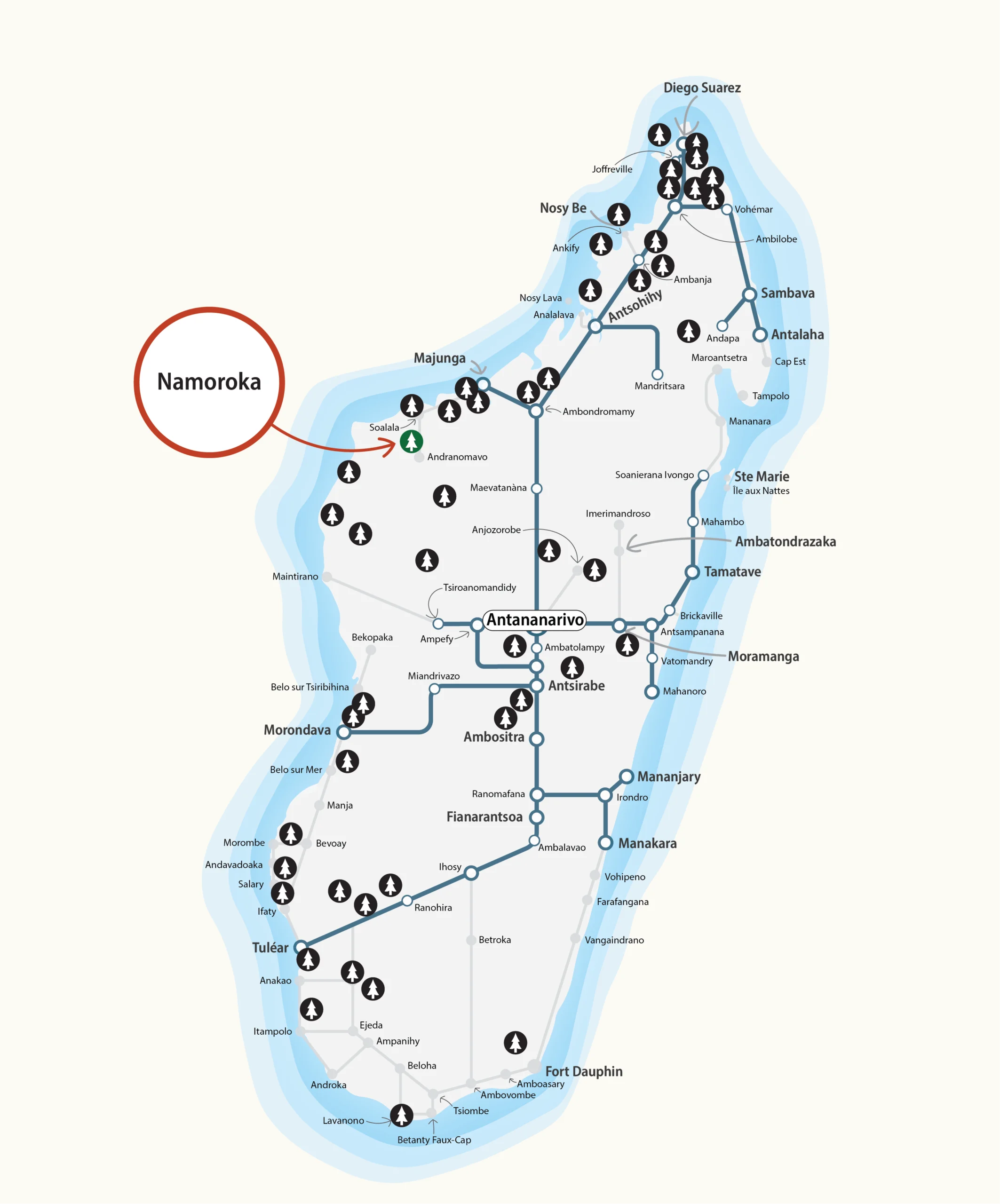
The park is accessible via a secondary road from Soalala (70 km). From Mahajanga, take the ferry to Katsepy, then follow the RNT19 or RIP112 to Soalala, approximately 150 km, around 8 hours by 4×4.
To reach the park from Mahajanga, cross by ferry to Katsepy, then take the RNT19 or RIP112 linking Katsepy to Soalala (150 km, approximately 8 hours by 4×4). From Soalala, a 70-km secondary road leads to the park entrance. All routes require a robust four-wheel-drive vehicle.
Fauna and Flora
Dry forest and tsingy, endemic at every turn
The park's climate is dominated by the dry conditions typical of the north-western zone: a cool season from June to August with minimum temperatures of 15.5 °C, a hot season from September to November peaking above 34.1 °C, and a rainy season between November and April.
Namoroka is defined by its tsingy: a massif of sharp limestone spurs where exposed rock forms the dominant substrate. The northern portion is covered by dense dry forest, characterised by Fabaceae (Delonix boiviniana and Neoharmsia madagascariensis), Malvaceae (Hildegardia erythrosiphon), Commiphora, and Adansonia rubrostipa. The endemic plant of Namoroka belongs to the Sphaerosepalaceae family, with two species: Rhopalocarpus lucidus and R. similis.
The southern section transitions into forested limestone outcrops, grasslands, and pastures. In the south-east, two networks of riparian forest line the watercourses. The protected area supports 31 reptile species, including the endemic chameleon Brookesia bonsi, as well as 102 bird species, 21 bat species, and 9 lemur species.
Culture and Heritage
Sakalava sacred sites and the Mandevy river
The protected area contains sacred Sakalava sites (Doany) and ritual ceremony grounds (Joro), notably along the Mandevy river. The localities of Andriabe and Antaboaka Kapiloza shelter a sacred site with hot springs.
The principal threat to the park is bush fires linked to the burning of grasslands for livestock. Timber extraction remains limited by comparison.
Identified threats
Location
North-western Madagascar, Boeny Region
Namoroka National Park lies 150 km south-west of Mahajanga, accessible by ferry to Katsepy then road to Soalala, followed by a 70-km secondary track to the park entrance. The manager's office is located in Soalala.