Protected Area · North-West Region · Protected Areas of Madagascar
Bombetoka
Beloboka
A vast estuarine landscape of mangroves and dry forests on the Betsiboka, refuge of flamingos, sacred ibises, and the rare Propithecus coquereli sifaka.
About the protected area
Betsiboka estuary, cloaked in mangroves
The Bombetoka Beloboka Protected Area covers the estuarine reaches of the Betsiboka River, draped in approximately 46,000 hectares of riverine mangroves framed by dense dry forests. Created in 2015, it incorporates the Classified Forest of the Betsiboka Mangroves, which has been under formal protection since 1958. The area is managed by the Development and Environmental Law Center (DELC) Madagascar, whose office is based in Mahajanga.
The protected area encompasses the bay's 28 islands, whose mangroves vary in composition according to their degree of salinity, flooding regime, and sedimentation. Riparian forest corridors link the forested blocks along the valleys, complemented by swamp formations, raphia palm stands on clay lowlands, and grassy marshes.
No visitor infrastructure has been recorded within the protected area. Visit and stay arrangements must be discussed directly with the manager, whose office is located in Mahajanga.
The protected area is accessible by sea, by motorboat or dugout canoe from Mahajanga, reaching Sankoany (site of celestite mines), the village of Mahataitromby for the dry forests, or further upstream along the Betsiboka for the mangrove forests. By road, take the RN4 (Mahajanga–Antananarivo) and, 15 km along, branch south-west for 20 km to the village of Boanamary, where dugout canoes can be hired for access to the protected area.
Fauna and Flora
Mangroves and dry forest, a sanctuary for waterbirds
The climate is typical of the north-western region: a cool season from June to August with minimum temperatures of 16.5 °C, followed by a hot season from September to November peaking above 34.7 °C, and a rainy season between November and April.
The protected area contains fragments of dense dry forest, xerophilous thicket on calcareous rocky outcrops, riparian forest linking the forest blocks along the valleys, swampy formations including raphia palm stands on clay lowlands, and grassy marshes. The estuary's shores and 28 islands host mangroves of every type, differentiated by their salinity, flooding intensity, and sediment conditions.
The protected area shelters 111 bird species, including a rich array of waterbirds: sacred ibises, greater flamingos, spoonbills, egrets, ducks, herons, and the Madagascar Fish Eagle. In its northern reaches, visitors may encounter two sifaka species, Propithecus coquereli and Propithecus coronatus.
Culture and Socio-economic Practices
Mangroves under pressure, from charcoal to rice fields
The forests of Bombetoka are in an advanced state of degradation due to timber cutting and charcoal production activities. In the upper reaches of Betsiboka Bay, local communities convert mangrove areas into rice paddies.
Fires are also widespread for various reasons: pasture burning, charcoal-making-related fires, and slash-and-burn agriculture.
Identified threats
Location
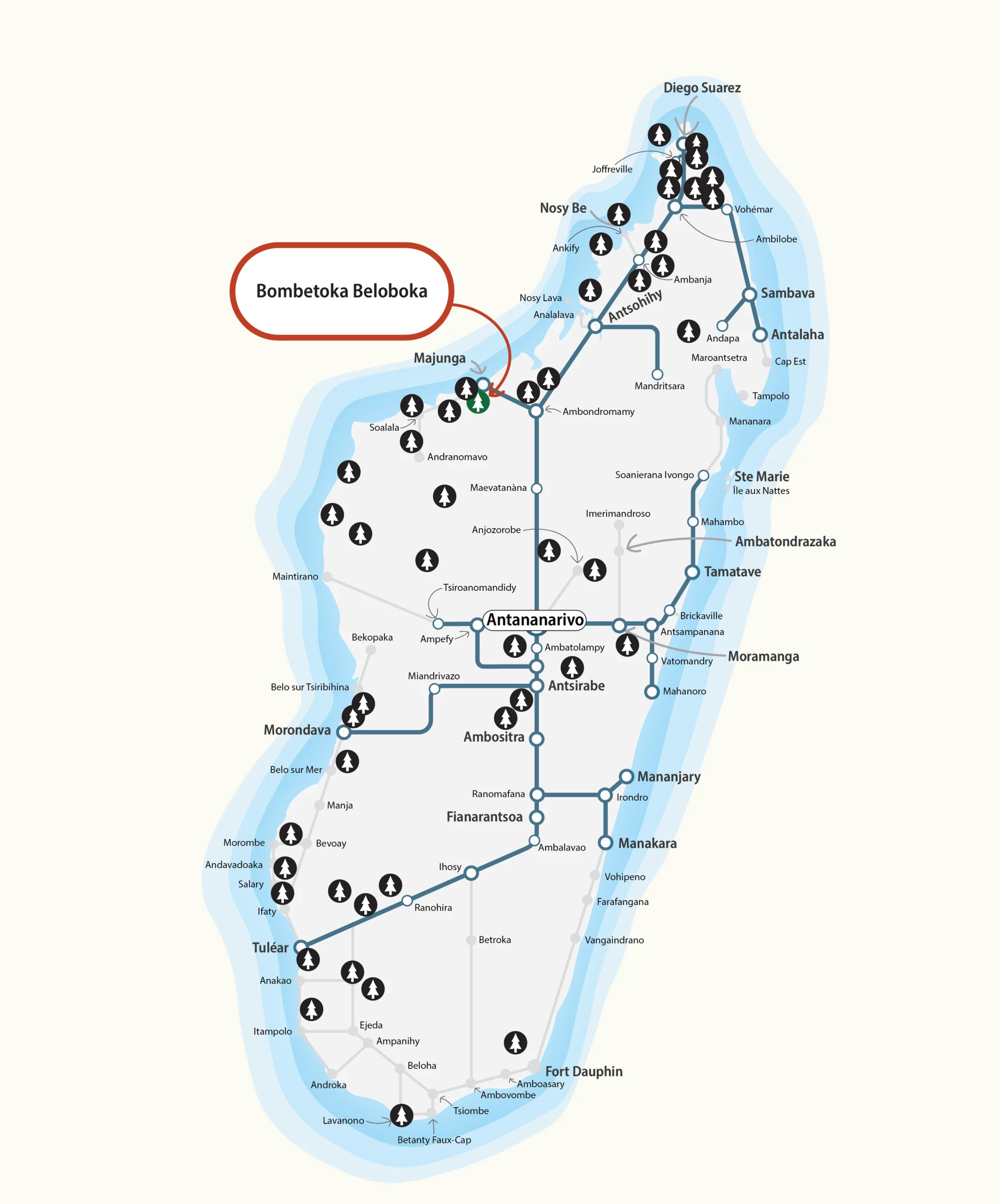
North-western Madagascar, Betsiboka Estuary
The Bombetoka Beloboka Protected Area encompasses the Betsiboka River estuary near Mahajanga. Access is either by sea from Mahajanga, or overland via the RN4 to the village of Boanamary (35 km from Mahajanga), where boats can be hired. The manager's office is located in Mahajanga.