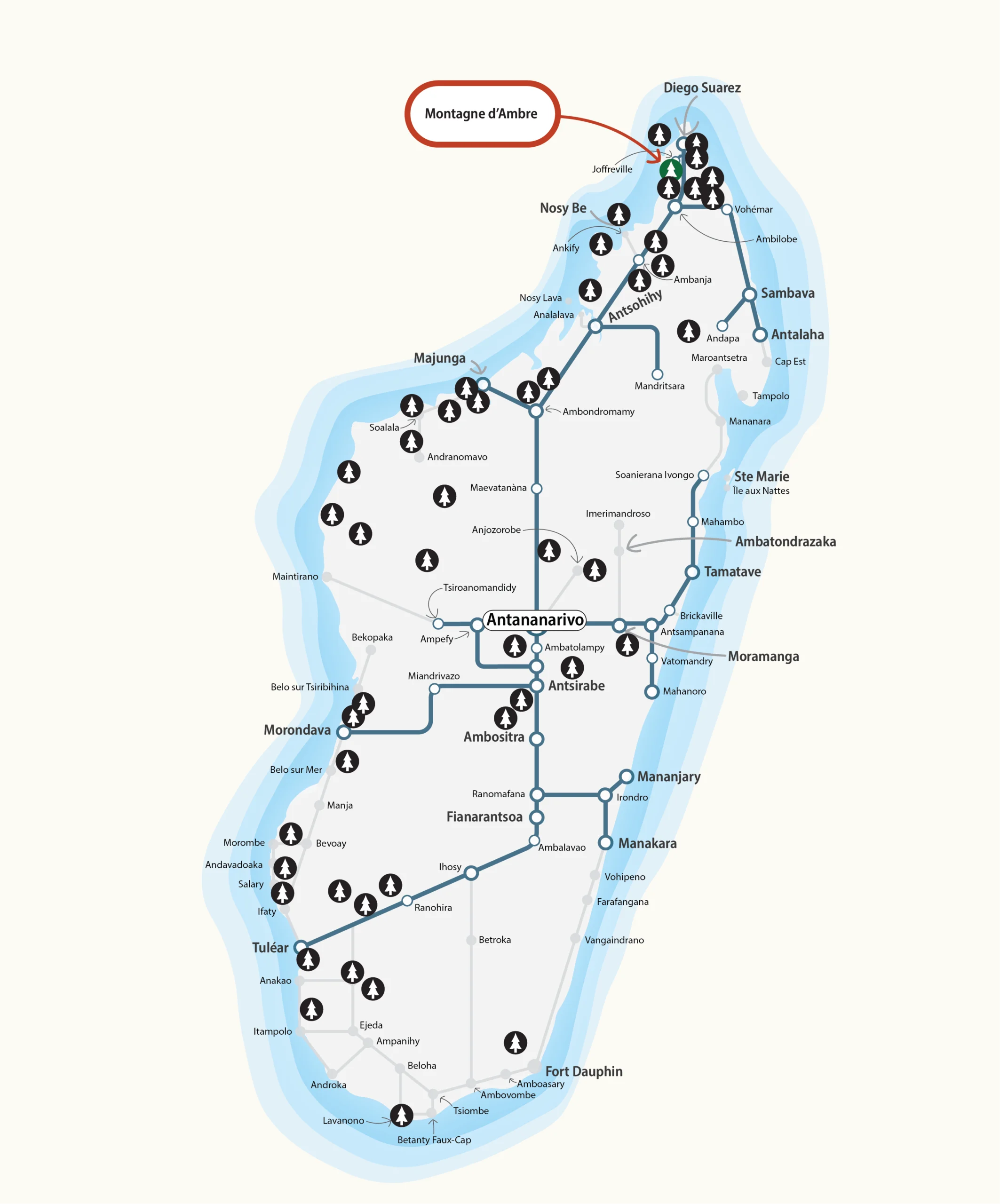
National Park · Northern Region · DIANA · 35 km from Antsiranana
Montagne d'Ambre
National Park
An isolated volcanic massif rising to 1,475 m, cloaked in humid rainforest and crater lakes, in the far north of Madagascar.
About the protected area
Volcanic massif, crater lakes and ancient rainforest
Montagne d'Ambre National Park is located 35 km southwest of the city of Antsiranana, in the DIANA Region. The Montagne d'Ambre is an isolated volcanic massif reaching 1,475 m in altitude. The park manager's office is situated at the site entrance, with two sector offices located respectively at Antsahampano to the north and Anivorano Avaratra to the south.
In 2015, the Amber Forest Special Reserve and the Montagne d'Ambre National Park, both established in 1958, were merged into a single protected area: Ambre National Park. The Roussette Forestry Station, created in 1937, became a service zone of the park.
The presence of volcanic craters is one of Montagne d'Ambre's most distinctive features. The massif harbours six crater lakes: Mahasarika (Petit Lac), Malio (Grand Lac), Taranta (Lac Maudit), Fantany, Coupe Verte, and Manonja (Lac Texier).
Fauna and Flora
A richly endemic ecosystem
Montagne d'Ambre National Park is covered by dry dense forest at its base and by mid-altitude evergreen humid dense forest to the east and at its summit zone. The park presents a unique form of forest hillock. The presence of Gambeya boiviniana forming secondary forest stands bears witness to the impact of cyclones on the site.
Several endemic plant species are present in the park: Barleria vincaefolia, Dioscorea sambiranensis, Psychotria bealananensis, Talinella psychopoda, Noronhia aminae, N. capuronii, N. crassinodis, and N. humbertiana. In total, 31 species are known only from Montagne d'Ambre.
The park is also home to four waterfalls: the Antomboka cascade, the tourist cascade, the Sacred cascade, and the Antakarana cascade.
Culture and Heritage
Antakarana and Sakalava traditions
The Antakarana and Sakalava are the dominant ethnic groups of the protected area. Certain sites within the park are used to organise rites and serve as places of sacrifice, reflecting the deep spiritual connection between these communities and the forest.
Pressures on the protected area include slash-and-burn agriculture, logging and forest product extraction, and bush fires.
Identified threats
Tourist circuits
Five trails across 34 km of forest
The park's tourist network spans 34 km and is divided into several circuits, with rest areas and viewpoints. Highlights include the Petite Cascade, Grande Cascade and Lac Maudit. Visit and guiding arrangements are to be discussed with guides at the site entrance.
-
Ampijoroana Circuit
3 km
Base camp trail -
Mahasarika Lake Circuit
2.7 km
Crater lake viewpoint -
Renard Crater Circuit
12 km
Volcanic crater exploration -
Olioly Circuit
12 km
Deep forest trail -
Atomboka Circuit
3.2 km
Waterfall trail
Location
Northern Madagascar, DIANA Region
Montagne d'Ambre National Park is located 35 km southwest of Antsiranana, accessible via the RN6 national road to Antanamitarana, then the road toward Ambohitra.