Marine National Park · RAMSAR Site · UNESCO Biosphere Reserve · North-West Coast
Sahamalaza –
Iles Radama
A tripartite marine park of coral reefs, coastal mangroves, and littoral forest, sheltering turquoise-eyed lemurs and locally endemic species along Madagascar's remote north-western shores.
About the Park
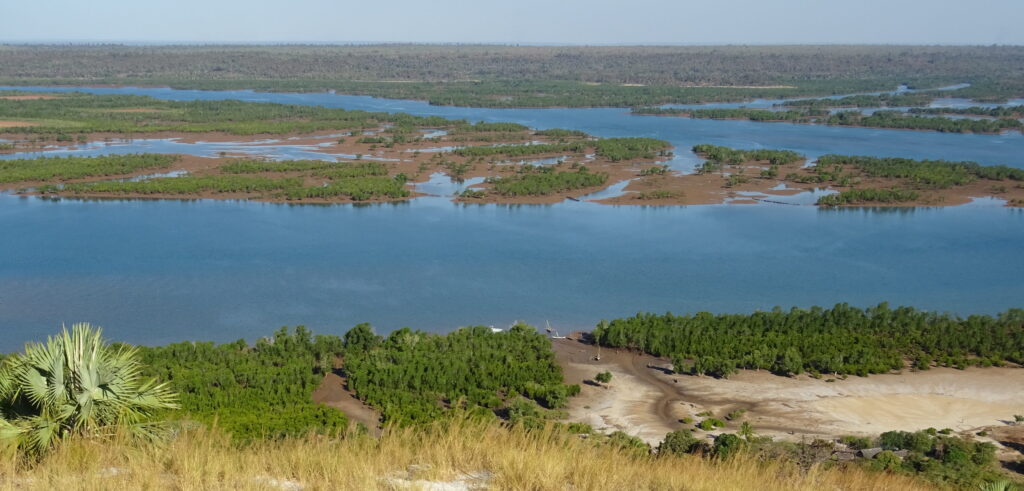
Coral reefs, mangroves, and littoral forest
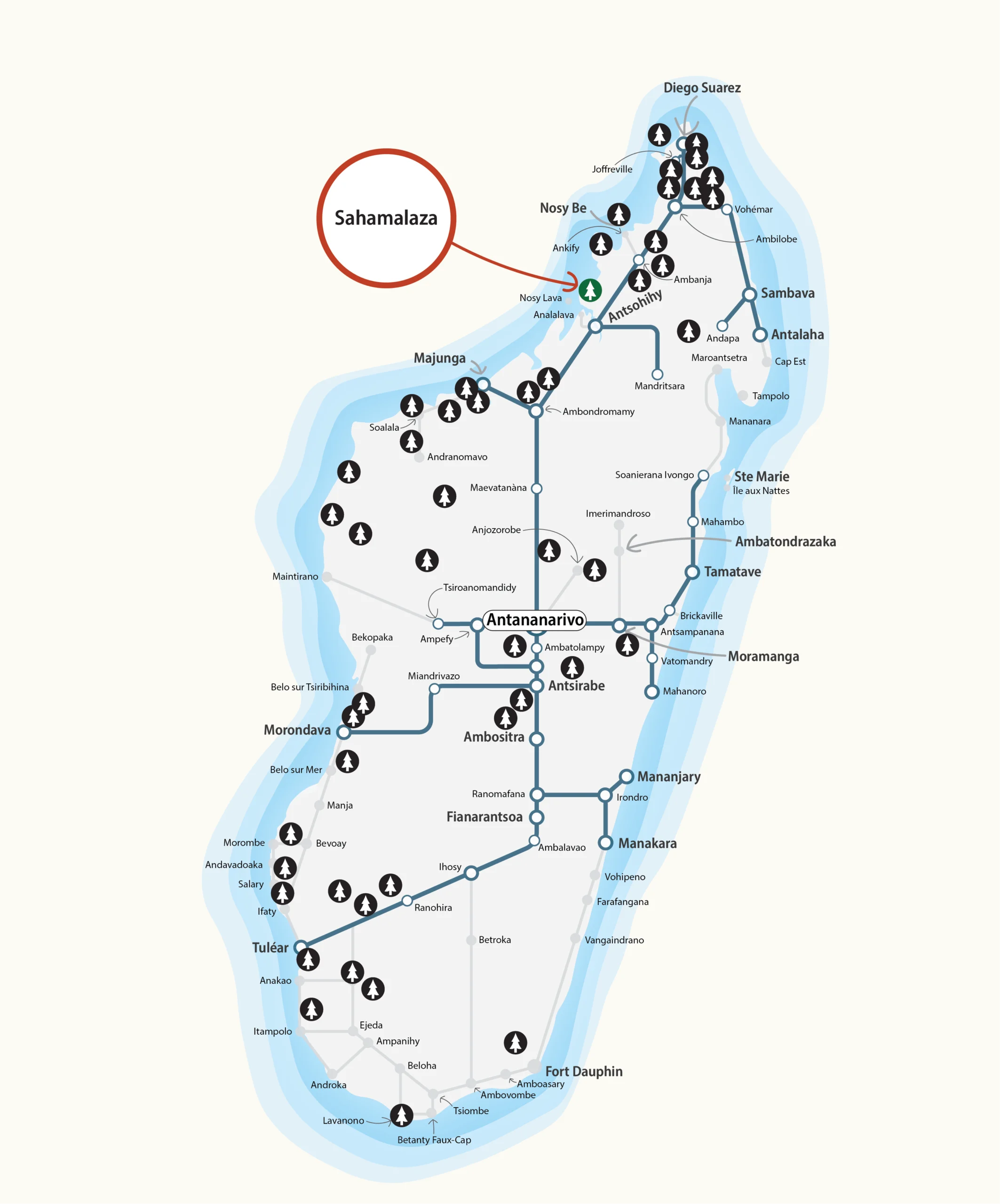
Sahamalaza–Iles Radama National Park stretches along Madagascar’s north-west coast, straddling the districts of Ambanja (Diana Region) and Analalava (Sofia Region). Nestled between the bays of Narindra and Mahajamba to the south, and the bays of Ampasindava and Nosy Be to the north, the park encompasses five rural communes of the Analalava district: Ambolobozo, Befotaka Nord, Maromandia, Ankaramy, and Anorotsangana.
Established in 2007 and managed by Madagascar National Parks, the park is structured around three distinct ecological zones: a marine parcel of coral reefs covering 12,696 ha, a coastal mangrove parcel of 5,796 ha, and a terrestrial littoral forest parcel of 7,483 ha. The Radama Islands, comprising Nosy Kalakajoro, Nosy Valiha, Nosy Faly (Antanimora), and Nosy Berafia, are integral to the park’s marine territory.
Home to the turquoise-eyed lemur Eulemur macaco flavifrons and several locally endemic vertebrates found nowhere else on Earth, Sahamalaza is one of Madagascar's most biodiverse coastal sanctuaries.
Key Fauna & Flora
Turquoise-eyed lemurs and endemic enclaves
The park’s forest cover is concentrated in two main patches at Ankarafa and Anabohazo-Ambohitra, set amid secondary formations of herbaceous vegetation, riparian forest, and raphia groves. Secondary forest, dominated by Mangifera indica, Sorindeia madagascariensis, and Micronychia taratana, gives way to shrubby thickets harbouring lianas (Clitoria lasciva, Mucuna pruriens), bamboo, and secondary grassland.
Several plant species with restricted distributions have been recorded in and around the park, including Microsteira radamae (Malpighiaceae), known only from the Radama Peninsula and the Menabe, and Ochna sambiranensis.
Culture & Heritage
The Sakalava people and living traditions
Though ethnically diverse, the population of the park’s buffer zone is predominantly Sakalava. Social organisation is structured around deep respect for custom and tradition, with zebu cattle playing a central role in both ceremonial rites and economic life. The Sahamalaza region is divided into three traditional geographic zones, each led by an olomaventy, the village elder regarded as the custodian of local authority, who must be consulted before any activity is undertaken in his domain.
Many sacred sites are found within the park, including royal tombs. A rich set of customary observances governs behaviour at these places: shoes must be removed, the right foot must enter a house first, women must wear their hair loose and dress in lambahoany, and Tuesdays and Thursdays are observed as rest days on which no work is permitted. In certain locations, the extraction of natural resources is strictly prohibited or tightly regulated.
Primary conservation pressures
Access & Infrastructure
By sea or overland via RN6
The park is primarily reached by sea. Boats depart from Maromandia (via MNP) or from Hôtel La Cascade at Marovato Sud, and connections are also available from Nosy Be and Antsohihy. By road, the park lies on National Route 6 linking Mahajanga to Antsiranana, 121 km north of Antsohihy and 96 km south of Ambanja.
The main management office is at Maromandia, with two sector offices at Maromandia and Antafiabe. Tourist reception points are located at Antafiabe and Marovato. The Ankarafa research camp, operated by the European Association for the Study and Conservation of Lemurs (AEECL), offers an equipped campsite. Visit and accommodation arrangements should be discussed directly with park management.
Visit and stay arrangements to be discussed with park management at the Maromandia or Antafiabe offices.
North-West Coast, between Diana & Sofia Regions
Sahamalaza – Iles Radama straddles the Diana and Sofia regions on Madagascar’s north-west coast, between the bays of Narindra and Mahajamba to the south and the bays of Ampasindava and Nosy Be to the north. It is most conveniently reached from Nosy Be by boat, or overland via the RN6 highway.