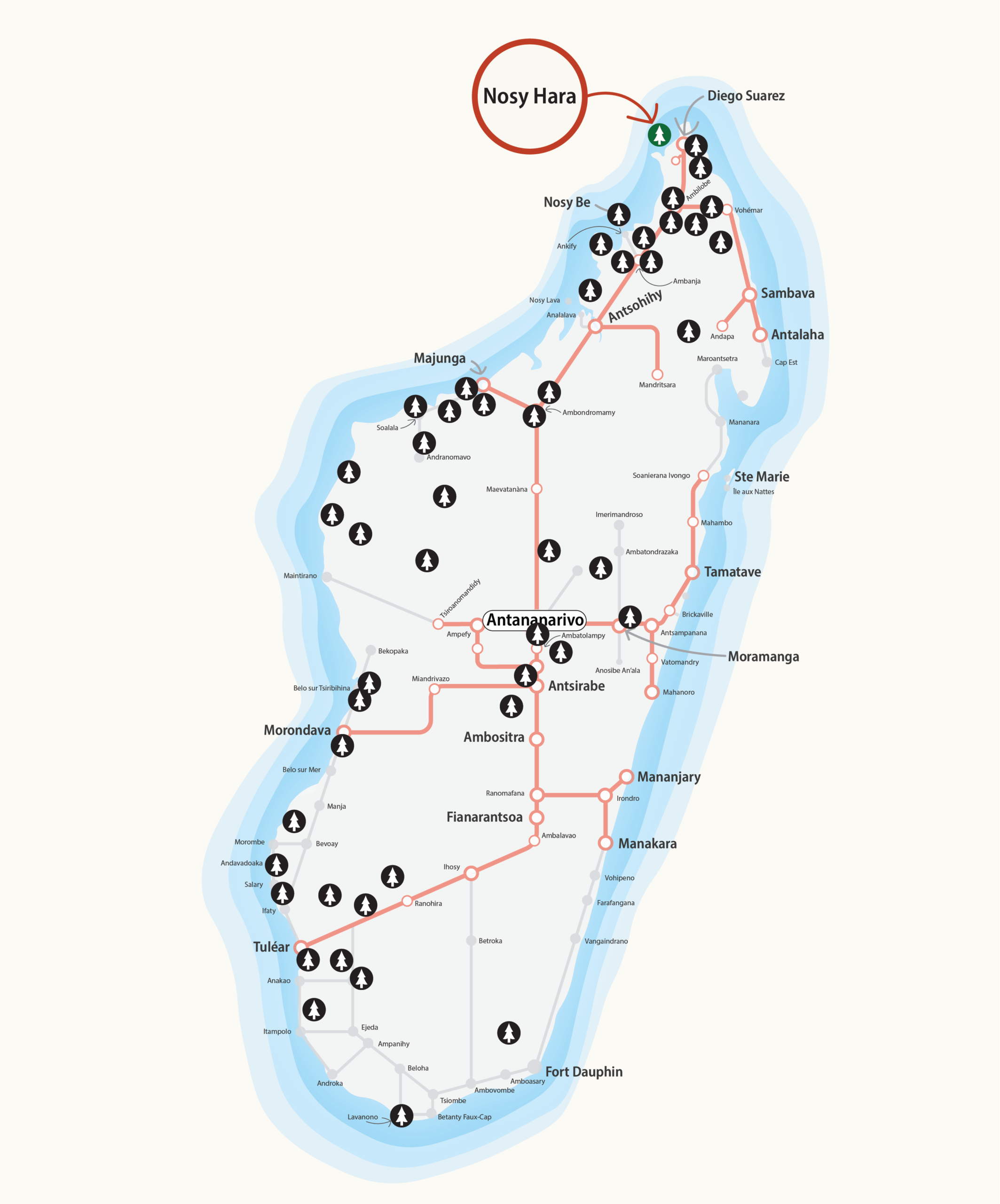
National Park · 12-Islet Archipelago · DIANA Region · Protected Areas of Madagascar
Nosy Hara
National Park
Twelve limestone islets scattered across Madagascar's Baie du Courrier — a karst archipelago of eroded tsingy cliffs and coral reef, home to Brookesia micra, the smallest chameleon on Earth.
About the protected area
Twelve islets of karst and coral
Located off the north-west coast of Madagascar in the DIANA Region, Nosy Hara National Park is made up of 12 islets and includes a marine park. The protected area covers 125,471 hectares in total: 122,827 hectares for Parcel 1, which includes the Baie du Courrier and the Nosy Hara archipelago; 1,437 hectares for Parcel 2, which includes Nosy Faty; and 628 hectares for Parcel 3, comprising Nosy Agnabo.
Each island is formed of heavily eroded limestone, giving rise in places to karst tsingy formations. The park is recognised as a Key Biodiversity Area within the new Cap Anorontany Archipelago protected area.
The manager maintains an administrative office at Ampasindava and two sector offices — one for the North at Lalandakana and one for the South at Befotaka. Six guard posts are spread across Befotaka, Lalandakana, Mangaoka, Nosy Hao, Nosy Hara, and Nosy Lakandava. A welcome office and an interpretation centre are located at Ampasindava. An equipped campsite exists at Nosy Hara, the Anjavavy Camp (7 unsheltered tent pitches and 3 tent shelters); at Nosy Andatsara, the Camp Corail lodge is run by a private operator (www.newsearoc.com) that also maintains equipped climbing routes. Visit and stay arrangements are to be discussed with guides on site, at the entrance to each location.
Nosy Hara shelters Brookesia micra, recognised as the smallest chameleon in the world — one of the archipelago's signature endemic species.
Climate, Fauna and Flora
Dry forest and tsingy scrub, home to a chameleon found nowhere else
The protected area sits under the dry climate typical of northern Madagascar, distinct from that of the Central Highlands. Rain falls between November and April. The cool season runs from June to August, with minimum temperatures of 18.6°C, while the hottest season runs from December to February, with peaks of up to 35°C occurring between September and November.
Vegetation is shaped by this dry climate and by a trade wind that persists for nine months of the year. Plant communities range from dense dry forest to xerophilous rupicolous vegetation on the tsingy. The dense dry forest is sacred at Ambatorara (150 ha) and is also present at Ironana and on the limestone slopes along the park's coastline. It is composed mainly of Adansonia suarezensis and Commiphora; at Nosy Hara, the forest has developed within canyons, where it grows dense and humid. Plants such as Aloe, Adenia, Cynanchum, Pachypodium, Euphorbia, and a few Adansonia grow on the limestone plateaus. Littoral forest occurs at Nosy Hara, alongside mangroves at Andranomavo, Ankingameloka, and Ampasindava. Of the 8 mangrove species found in Madagascar, only Heritiera is absent here.
The only endemic plant present at Nosy Hara belongs to the Sphaerosepalaceae family: Rhopalocarpus suarezensis. As for fauna, Nosy Hara is home to 45 bird species and 19 reptile species, including the endemic Brookesia micra, recognised as the smallest chameleon in the world. Two amphibian species are also present, one of which, Stumpffia hara, is likewise endemic to the protected area. The lemur Cheirogaleus sp. was introduced to the park.
Culture and Heritage
Antakarana and Sakalava, guardians of sacred islets
The population of Nosy Hara National Park is composed of Antakarana and Sakalava communities. Certain sites within the park are considered sacred and shelter tombs.
Selective mangrove cutting, unauthorised boat anchoring in coral and seagrass zones, illegal fishing, and sea turtle poaching are the principal pressures weighing on Nosy Hara National Park.
Identified threats
Tourist circuits
Three trails across 5.7 kilometres of tsingy
Three networks of tourist circuits, totalling 5.7 km, are laid out on Nosy Hara, each fitted with rest areas and viewpoints. Visit and guiding arrangements are to be discussed with guides at the site entrance.
-
Brookesia Circuit
700 m
Home to the park's signature endemic chameleon species -
Tsingy Mitsiry Circuit
3 km
Through eroded karst limestone formations -
Falaise Circuit
2 km
Cliff-side trail with panoramic viewpoints
Location
Off Madagascar's northern tip
Nosy Hara National Park lies in the Baie du Courrier, reached by road from Antsiranana (Diego-Suarez) via Anamakia and Mangoaka to Ampasindava, where boats depart for the archipelago. Travellers from Antananarivo can follow the RN4 to Ambondromamy and the RN6 onward to Antsiranana before continuing to Ampasindava.