Natural Resources Reserve · Vakinankaratra Region · Protected Areas of the Highlands and Central Madagascar
Manjakatompo Ankaratra
Natural Resources Reserve
Guardian of Madagascar's third-highest summit, an 8,130-hectare highland reserve of ericoid thicket and montane forest, crowned by Tsiafajavona at 2,643 metres.
About the protected area
Third-highest massif of Madagascar
The Manjakatompo Ankaratra Natural Resources Reserve lies within the commune of Tsiafajavona Ankaratra, in the Vakinankaratra Region, and encompasses Tsiafajavona, the third-highest massif in Madagascar, rising to 2,643 metres. Covering 8,130 hectares, the site was first established in 1922 as the Manjakatompo Forestry Station (8,320 ha) before being instituted as a Natural Resources Reserve in 2015. It is managed by Vondrona Ivon'ny Fampandrosoana (VIF).
A control office stands at the site entrance, alongside a handful of buildings at the fish-farming station that can serve as a guesthouse or meeting room, with bivouac also possible there. The village of Manitongana offers community-run reception infrastructure. Visit and stay arrangements are to be discussed with the guides recommended by the manager.
Rising to 2,643 metres, Tsiafajavona is the third-highest summit in Madagascar, its peak reachable only by those willing to bivouac overnight on the mountain.
Fauna and Flora
Ericoid thicket and highland endemics
Manjakatompo Ankaratra shelters a natural forest of a few hectares, 80% of it composed of Dicoryphe buddleioides, Weinmannia stenostachya, and Ilex mitis. The ridgeline is dominated by a forest of Agarista and Erica, while nearby thickets give way to secondary growth mixed with an introduced Acacia species alongside further Agarista and Erica. The reserve is, for the most part, characterised by herbaceous cover, prairies and pastureland, together with montane ericoid thicket.
The site is rich in Asteraceae (76 species) and Orchidaceae (69 species). Sixteen plant species are found nowhere else, among them representatives of the Aponogetonaceae and Caryophyllaceae families, and Corrigiola madagascariensis. Manjakatompo Ankaratra is also home to two amphibians of note, Boophis williamsi and Mantidactylus pauliani, and a reptile, Lygodactylus mirabilis, while the gecko Phelsuma barbouri is present on the summit zones.
Fauna
Flora
Culture and Heritage
Taboos, oaths and a king's decree
The surrounding communities observe a number of fady, taboos on pork, garlic, rum and other products. Several sites associated with oath-taking and ritual offerings lie within the reserve, among them ancestral tombs. A local legend tells of a king who once decreed that anyone who exploited the forest would be cursed with miserable descendants, a belief that has long helped safeguard the forest canopy.
Charcoal production from Pinus plantations is the principal threat facing Manjakatompo Ankaratra, compounded by the spread of an invasive Pinus species into the reserve's natural forest.
Identified threats
Tourist circuits
Four trails towards summit and lake
The reserve offers four circuits, ranging from an easy walk, bike ride or drive to the Cold Lake and the Petite Cascade, to a full overnight ascent of Tsiafajavona summit. Visit and stay arrangements are to be discussed with the guides recommended by the manager.
-
Faravohitra Circuit
Car accessible
To the Cold Lake and the Petite Cascade, on foot, by mountain bike, or by car -
Ambatomalama Circuit
2h30
A direct route across the reserve -
Ambatomalama – Anosiarivo – Faravohitra Circuit
6h
An extended traverse linking three points across the reserve -
Tavolotara – Ambohimirandrana – Tsiafajavona Circuit
Overnight
Summit ascent of Tsiafajavona (2,643 m), bivouac required
Location
Central Highlands, Vakinankaratra Region
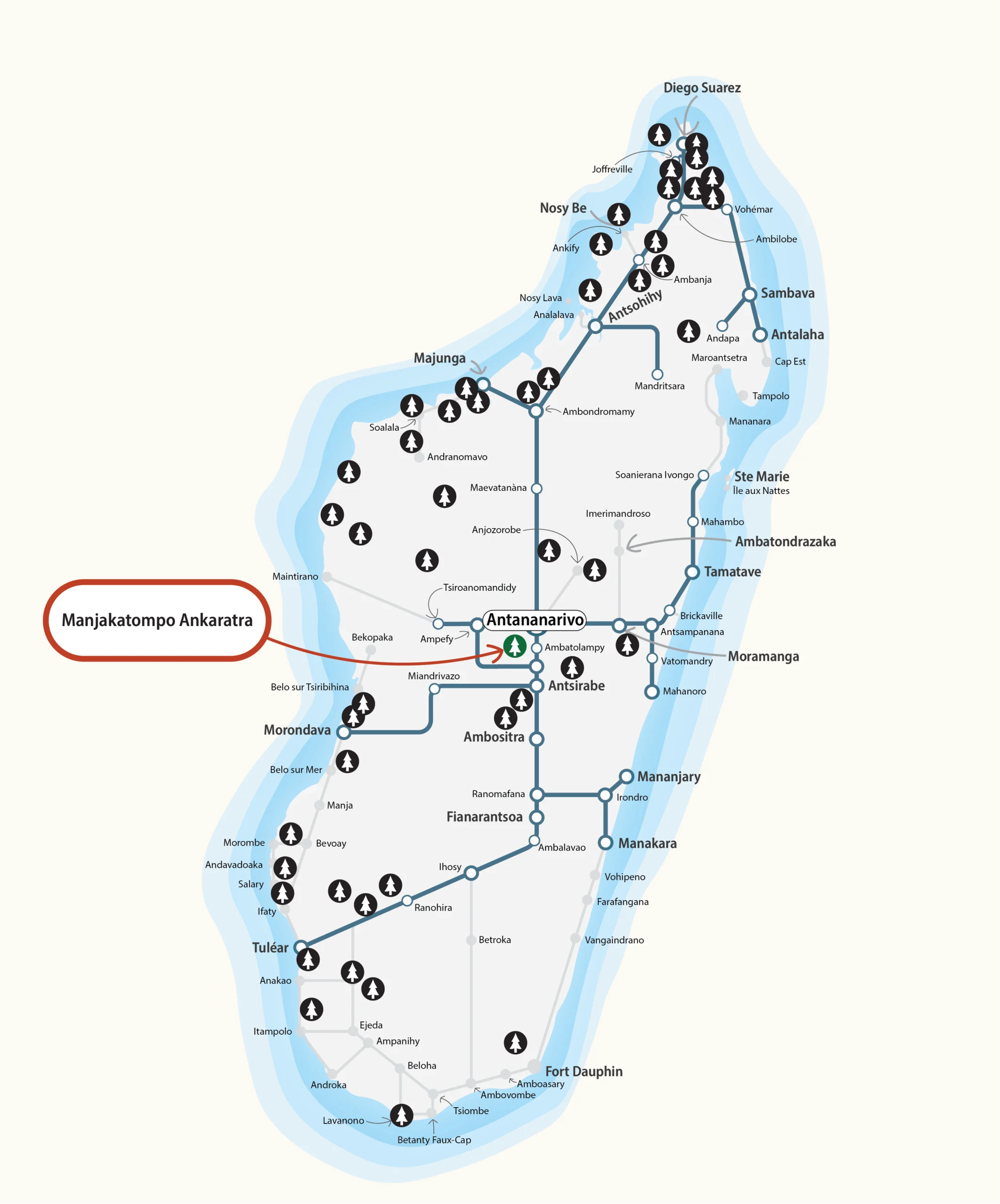
Manjakatompo Ankaratra Natural Resources Reserve is reached from Ambatolampy, 70 km south of Antananarivo on the RN7, by way of a 17 km secondary road leading to Manjakatompo and the trailheads of Tsiafajavona.