National Park · Highlands and Central Madagascar · Protected Areas of Madagascar
Marolambo
National Park
A vast highland wilderness of 95,199 hectares sheltering endemic lemurs, ancient forest and living cultural traditions, spanning four regions of central Madagascar.
About the protected area
A highland sanctuary at the heart of Madagascar
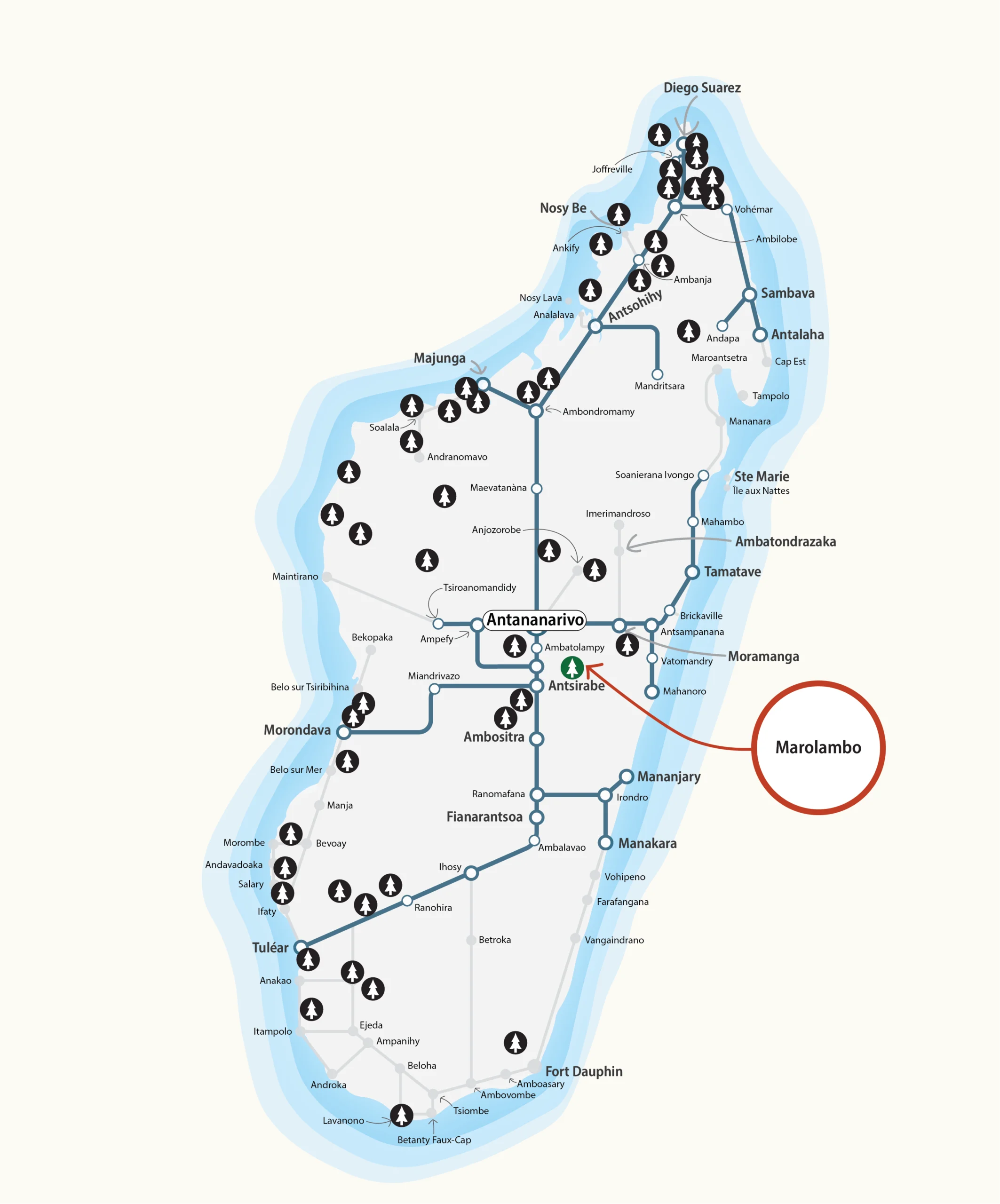
Marolambo National Park spans 95,199 hectares across four regions of central Madagascar: Atsinanana, Vatovavy-Fitovinany, Vakinankaratra and Amoron'i Mania. Established in 2015 and managed by Madagascar National Parks, it represents one of the most recent additions to the national protected area network.
The manager's office is based in Fandriana, supported by four operational field bases: Ambohitompoina (North sector), Sahakevo (East sector), Fasintsara (South sector) and Ankarinoro (West sector). No tourist infrastructure is currently in place within the protected area; visit, accommodation and guiding arrangements are to be discussed directly with the manager at the main site office.
Marolambo is home to Microcebus marohita, a mouse lemur found nowhere else on Earth, endemic to this single protected area.
Fauna and Flora
Dense evergreen forest, endemic at every stratum
The park is composed of dense, humid, sempervirent lowland and mid-altitude forest, exceptionally rich in epiphytes, above all orchids. Canopy trees including Dalbergia, Canarium and Vitex can reach 25 metres in height. Along the ridgelines at 1,800 metres, ericoid mountain thicket grows to 8 metres.
The eastern slopes are dominated by Ravenala madagascariensis and Harungana madagascariensis, alongside Trema orientalis and Psidium. To the west, the vegetation shifts to Lantana camara, Clerodendrum, Erica and Maesa lanceolata. Floristically, the park is distinguished by Peponidium latiflorum, Dalbergia monticola and Diospyros mangabensis.
Culture and Heritage
Seasonal rites, sacred ground and forest taboos
The communities surrounding the park observe a rich calendar of seasonal rituals: the cleaning of ancestral tombs (avandrazana) before the rains; the zebu sacrifice that precedes the rice harvest in May and June (santabary or satabokatra); the ceremony of the turning of the dead; and marriage requests made between July and September. These rituals unfold at sacred sites throughout the landscape. The pig is taboo within the forest.
Slash-and-burn agriculture, hunting, forest product collection, selective logging of precious timber and artisanal mining represent the principal pressures facing Marolambo National Park.
Identified threats
Access routes
Four approaches through highland and forest
The park is accessible from four directions, each serving a different sector. No tourist circuits are formally established; visit arrangements are to be agreed with the manager in Fandriana.
-
North
On foot
From Belanitra commune via Antanifotsy, 220 km from Antananarivo (RN7), then on foot to Antenina -
East
On foot
Accessible on foot only, to Sahakevo -
South
On foot
From Fasintsara, 96 km from Ambositra, then on foot to Ambinanisery -
West
4×4 / moto
From Tratrambolo, approximately 78 km from Fandriana via Miarinavaratra (4×4 or motorbike)
Location
Central Madagascar, Highlands and Eastern Slopes
Marolambo National Park straddles the highland and eastern escarpment zones of central Madagascar, accessible from Fandriana to the west or from Ambositra to the south. The manager's office in Fandriana is the recommended first point of contact for all visits.