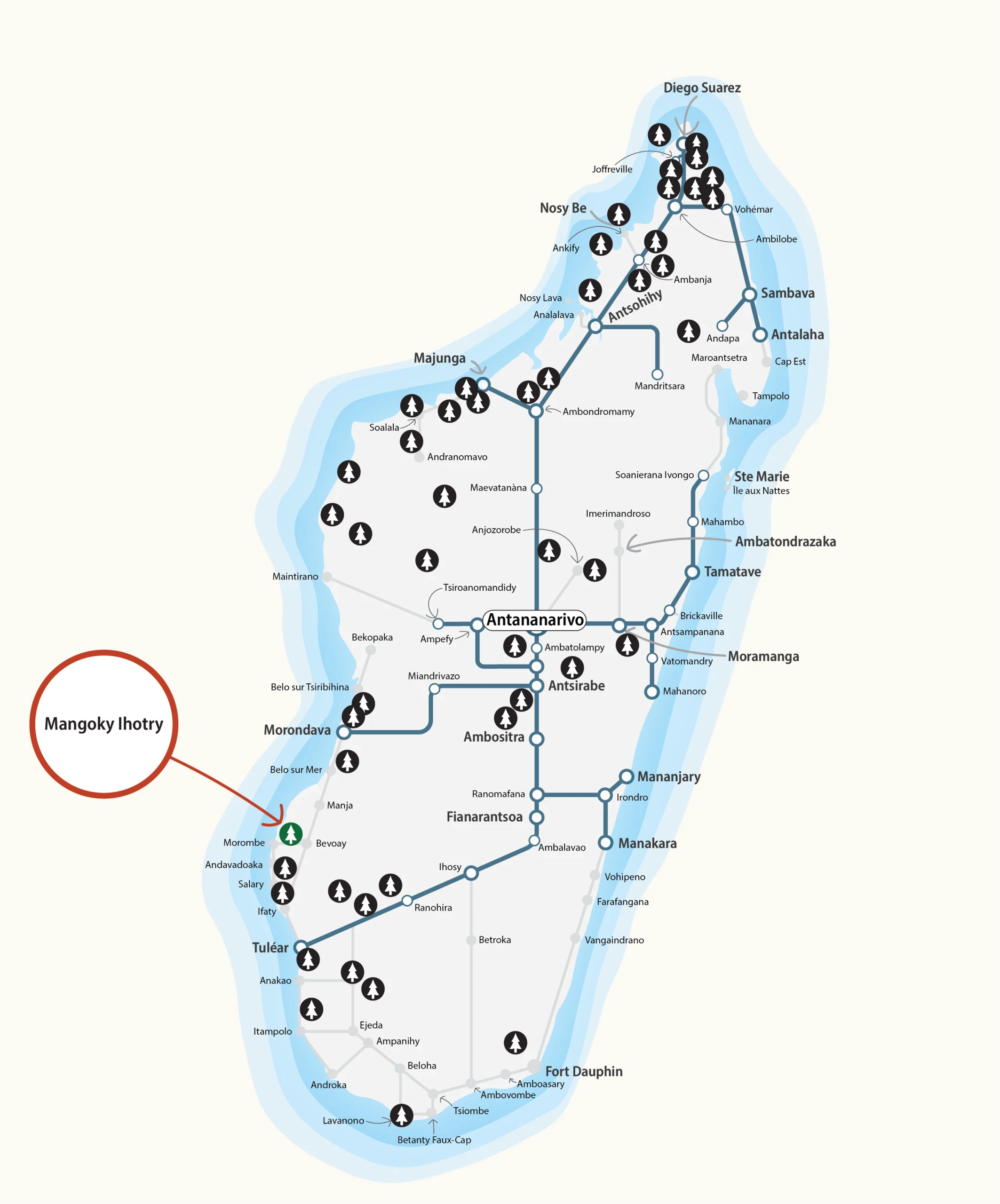
Harmonious Protected Landscape · South-West Madagascar · Protected Areas of Southern Madagascar
Mangoky Ihotry
Wetlands Complex
A vast mosaic of dry dense forest, freshwater habitats, mangrove delta and brackish lake along the south-western coast, home to the world's largest Adansonia grandidieri and over 143 bird species.
About the protected area
River, lake and delta, where three habitats meet
The protected area is shaped by the Mangoky River and the brackish Lake Ihotry. Accessible from the RN9 between Toliara and Morombe, it brings together three distinct habitat types: dry dense forest, freshwater environments, and coastal zones with mangroves.
The manager maintains an office in Morombe with an information centre. Visit arrangements, including access, circuits, guiding, and site conditions, must be discussed in advance. Three community management bases operate within the landscape, at Ihotry, Ambohibe, and Andranopasy. Accommodation is limited to the hotels of Morombe; there is no lodging infrastructure within the protected area itself.
Mangoky Ihotry holds the largest individual specimens of Adansonia grandidieri known anywhere in the world, the grandest of Madagascar's iconic baobab species.
Fauna and Flora
Baobabs, mangroves and exceptional birdlife
The eastern section supports dry dense forest occupying the valleys and banks of the Mangoky, continuing the forest belt of Kirindy Mitea to the north-east. Mangroves line the small bays and the Mangoky delta, while grasslands and secondary pasture dominate the terrestrial zone around Ihotry.
The flora is dominated by Adansonia grandidieri, with the largest known specimens found at Mangoky Ihotry. The endemic plant family Sphaerosepalaceae is represented here by Rhopalocarpus lucidus. The protected area supports an exceptionally rich avifauna of at least 143 species.
Socio-economic practices and threats
Deforestation, overfishing and a landscape under pressure
Local communities practise hatsake, the conversion of forest to arable land, alongside illegal extraction of mangrove timber, overfishing, and the use of fish poison derived from Euphorbia laro. Shifting agriculture and the settlement of communities within the protected area are the primary drivers of habitat loss.
Since 1996, the protected area has lost 24.2% of its dry dense forest and dry spiny thicket, with the rate of loss accelerating between 2006 and 2016. Mangrove cover has declined by 0.2% over the same period.
Identified threats
Location
South-West Madagascar, RN9 corridor
The Mangoky Ihotry Wetlands Complex is accessible from the RN9 between Toliara and Morombe. Visit arrangements, access routes, circuits, and guiding, should be agreed with the manager's office in Morombe before departure.